
Executive Summary
In vivo genomic medicines, and in particular systemically delivered base and prime editors carried in lipid nanoparticles, promise something the existing therapeutic paradigm was not built to deliver: a single, durable, potentially curative correction of a disease-causing mutation. The framing that follows naturally is molecular surgery, the idea that such an intervention behaves less like a chronic drug and more like a definitive procedure performed once at a specialized center. This paper examines, without overclaiming, what that framing can and cannot support today, what is actively changing, and what would have to become true for genomic correction to be developed, approved, paid for, and accessed at scale.
The central finding is structural. Treated as a procedure is not one status but four separable layers: regulatory classification, reimbursement, delivery, and clinical concept. A genomic editor lands very differently on each. As a manufactured, characterized, batch-released article, an industrialized editor is a biologic licensed under Section 351 of the Public Health Service Act.2 No amount of procedural framing converts the manufactured product itself into the practice of medicine.
*Classification follows the manufactured and reproducible character of the article, not its curative intent, its definitiveness, or the setting in which it is delivered.*
The procedure-style attributes that matter, namely certified centers, episode or outcomes-based payment, patient matching, and lifelong follow-up, live in the delivery, payment, and registry layers that sit on top of a product approval rather than in place of it. The existence proofs are already in the market: CAR-T, and the sickle cell gene therapies paid under the CMS Cell and Gene Therapy Access Model.12, 22 A striking set of policy instruments is now in flight that, for the first time, recognizes the platform and individualized character of this modality directly. The payment side of this problem has been mapped in depth by MIT NEWDIGS, ICER, and Duke-Margolis;30 the contribution here is the classification architecture beneath it and, in Part D, the manufacturing-assurance layer that could eventually move it.
The paper is organized in four registers. Part A sets out the settled legal architecture. Part B details the active 2024 to 2026 policy wave: the Plausible Mechanism Framework, the Leveraging Prior Knowledge genome-editing guidance, the Platform Technology Designation program, and the FRAME distributed-manufacturing workstream. Part C assesses what would have to be true for an upstream, transplant-style classification to exist at all, the routes that survive scrutiny, and the deepest obstacle, which is class-wide manufacturing risk. Part D turns constructive. It shows how emerging technology, including artificial intelligence, digital twins, and validated computational modeling, could meet that obstacle, and it sketches a new genomic-correction category in which a single molecular correction is governed as one coherent system.
Having led development for therapies given once and for therapies given repeatedly, the difference I keep returning to is that a durable product moves the burden of proof forward in time. The evidence a sponsor needs does not all exist at approval, and every part of the architecture below is an answer to that single fact.
1The Question, Stated Precisely
Genomic medicine forces a question the regulatory system has never had to answer cleanly. When a treatment is administered once and is intended to fix a defect permanently, is it a product or a procedure? The instinct behind the question is sound, but the word procedure conceals four distinct claims that must be evaluated separately (Exhibit 1).
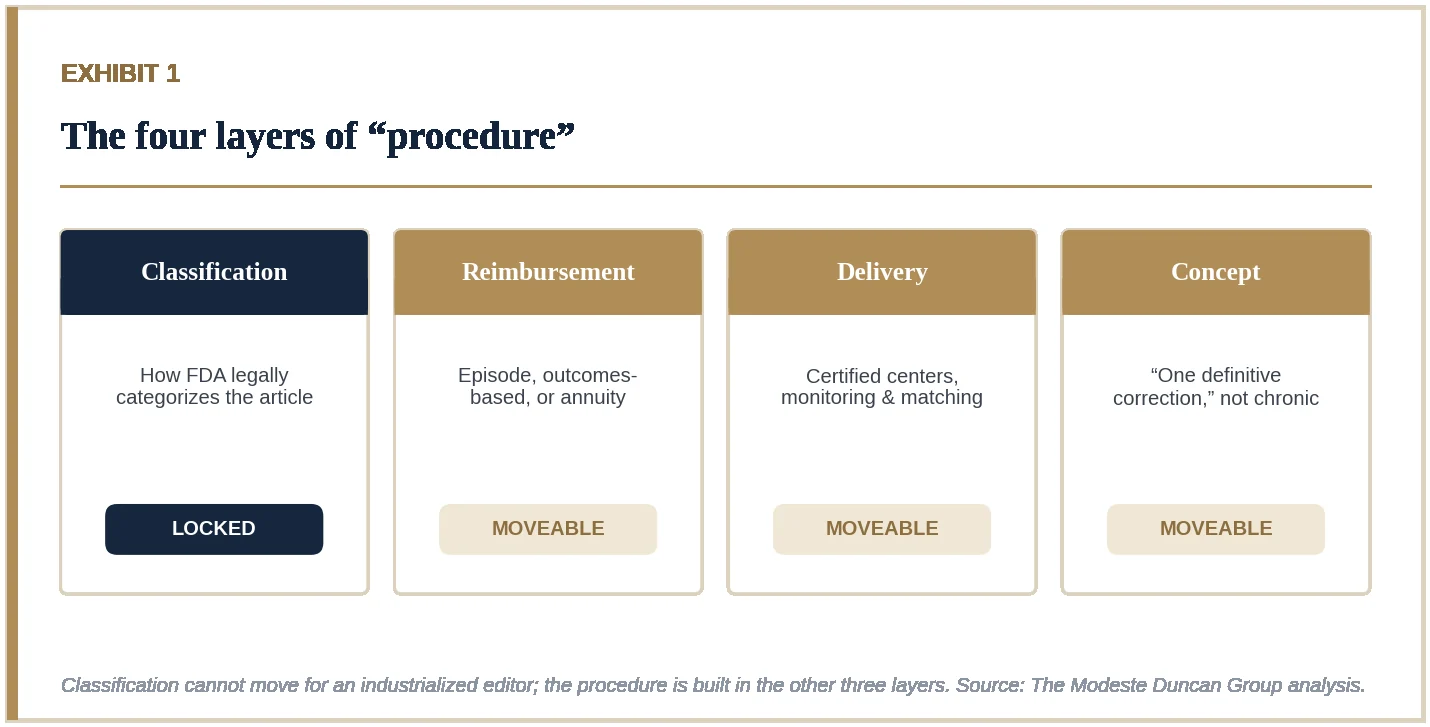
Exhibit 1. The four layers of “procedure.” Source: The Modeste Duncan Group analysis.
Conflating these layers is the most common way the molecular-surgery thesis is dismissed in diligence. The discipline this paper imposes is to keep them apart: to concede where classification cannot move, and to be precise about where payment, delivery, and concept genuinely can. The governing principle is that U.S. regulatory classification follows the manufactured and reproducible character of the article. Everything else is a consequence of that fact.
Part A · Existing Elements
The Settled Architecture
A.1 The product foundation and the biologic and device line
The threshold determinant is mechanism of action. A device achieves its purpose through physical or structural means and is not metabolized. A biologic acts through chemical or biochemical interaction and is metabolized to achieve its effect.3 An LNP-delivered editor is taken up by hepatocytes, translated into an editing protein that rewrites a base in genomic DNA, and then cleared. That is the textbook definition of a biologic. The editor therefore takes a Biologics License Application under PHS Act §351,2 reviewed by CBER. The only legitimate place device enters is adjacent: the companion diagnostic that determines whether a patient carries an editable allele.
A.2 The tissue-product escalator and where editing sits
The regulation of human biological material is organized by 21 C.F.R. Part 1271, which sorts products along a risk escalator.4 Minimally manipulated, homologous-use material can qualify as a 361 product, regulated for safety only. Anything that fails those prongs is a 351 biologic that requires an Investigational New Drug (IND) application and a BLA. Genome editing is the opposite of minimal manipulation and homologous use, so it sits on the top rung (Exhibit 2).
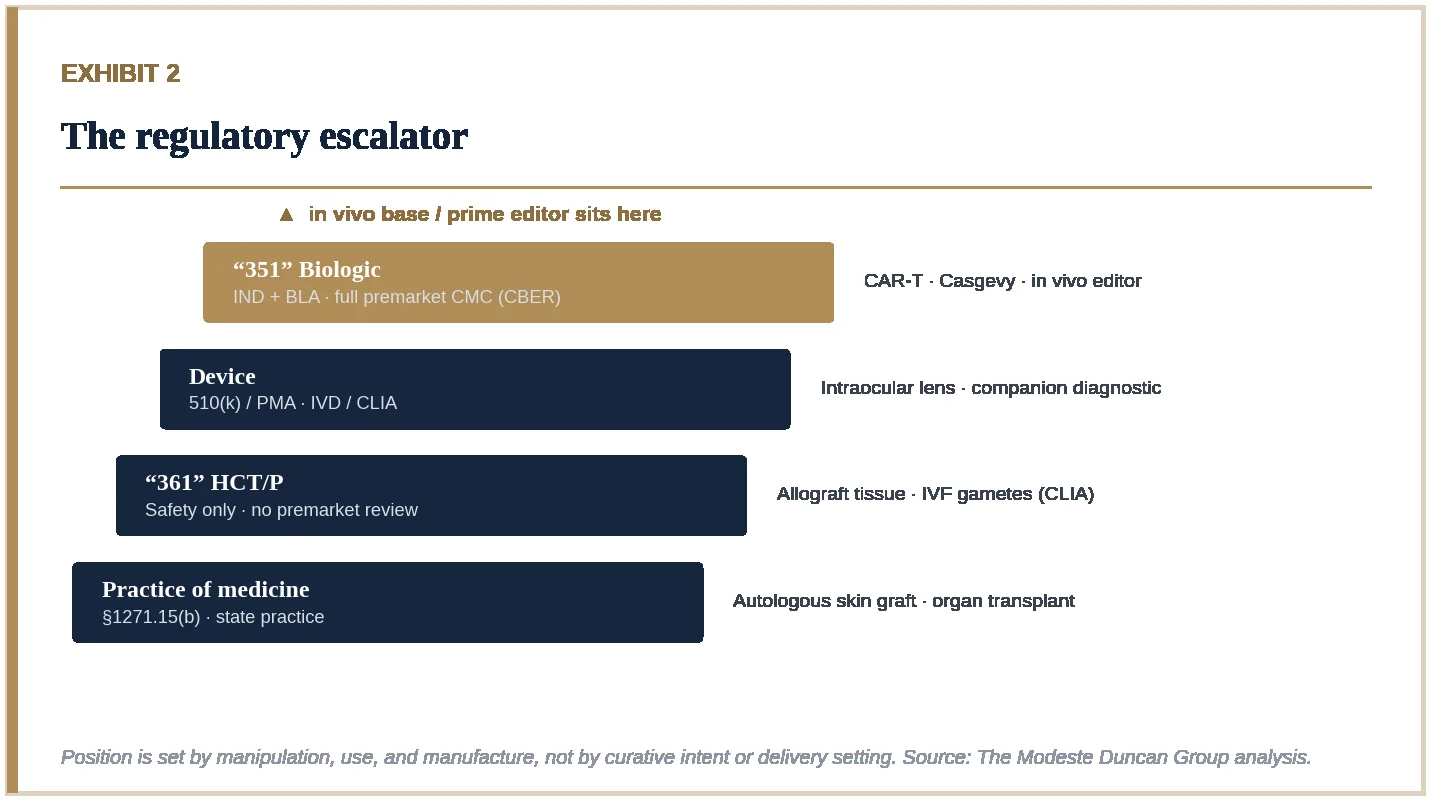
Exhibit 2. The regulatory escalator. Position is set by manipulation, use, and manufacture. Source: The Modeste Duncan Group analysis.
A.3 The organ-transplant boundary: an analog for every layer but classification
Solid-organ transplantation is the cleanest case of a biological intervention the whole system treats as a procedure, and yet FDA approves essentially none of it. Organs are procured and allocated under the National Organ Transplant Act, through HRSA and the OPTN and UNOS network, with center certification and episode payment supplied by CMS.1 The reason is decisive and transferable: an organ is not manufactured. The moment an organ is engineered, as in a gene-edited xenograft, it crosses back into FDA jurisdiction as a biologic. Transplant is therefore a powerful analog for concept, delivery, and payment, and a weak analog for one thing only, which is classification. That single distinction is what a diligence narrative must state plainly rather than blur.
A.4 Procedure-style delivery and payment precedents that already operate
The procedure architecture that genomic medicine aspires to is not hypothetical. Several FDA-approved products are already delivered and paid as procedures:
• CAR-T. A manufactured biologic delivered as a procedure-like episode, with apheresis, lymphodepletion, infusion, and toxicity monitoring at certified centers, paid through transitional add-on payments and dedicated diagnosis-related groups (DRGs).
• Casgevy and Lyfgenia. Gene-editing and gene-addition therapies delivered as a transplant-style episode and reimbursed through bespoke CMS arrangements.
• Implantable devices, radioligand therapy, ophthalmic implants.
Each separates the approved article from the procedural act. Bioerodible ophthalmic implants model a finite re-treatment cadence that is still a procedure, not chronic therapy.
• IVF. Tissue regulated for safety only, a clinical act that is the practice of medicine, laboratory oversight under CLIA, and outcomes reported under the FCSRCA. This is a quality scaffold entirely outside FDA premarket approval.24
A.5 The CMS Cell and Gene Therapy Access Model
On the payment layer, the most important existing instrument is the CMS Innovation Center's Cell and Gene Therapy Access Model, which began with the two sickle cell gene therapies. CMS negotiates outcomes-based agreements on behalf of states, ties payment to whether the therapy delivers its benefit, provides rebates if it does not, and coordinates ancillary costs. Participation covers the large majority of affected Medicaid beneficiaries.22 For an ultra-rare genomic platform, this is early evidence that a curative, one-time correction can be paid through a centrally negotiated, outcomes-linked, registry-supported mechanism rather than a conventional per-dose price. The broader design space for these payments, including milestone contracts, annuities, and reinsurance pools, has been mapped in detail by MIT NEWDIGS, ICER, and Duke-Margolis.30 This paper takes that work as given and concentrates on the classification and manufacturing-assurance layers those bodies do not address.
A.6 Existing development tools and the point-of-care boundary
Several development instruments are already settled: Regenerative Medicine Advanced Therapy designation,8 the January 2024 final guidance on gene therapy products incorporating genome editing, with long-term follow-up of up to fifteen years,13 and the individualized §561 pathway behind the first bespoke n-of-1 therapies.7 Point-of-care manufacture does not change any of this. Biological products are excluded from the §503A and §503B compounding exemptions, and FDA has stated that there is no legal pathway for marketing biologics prepared outside an approved BLA.5, 6 The United States has no hospital-exemption analog to the EU's ATMP provision.24 Manufacturing at the bedside relocates the factory. It does not reclassify the article.
Part B · Elements in Flight
The 2024–2026 Policy Wave
A cluster of FDA and CMS actions over the past two years has begun, for the first time, to recognize the platform and individualized character of genomic medicine directly. Several are draft guidances whose final form is not settled. That matters for how heavily a diligence narrative should lean on them (Exhibit 3).
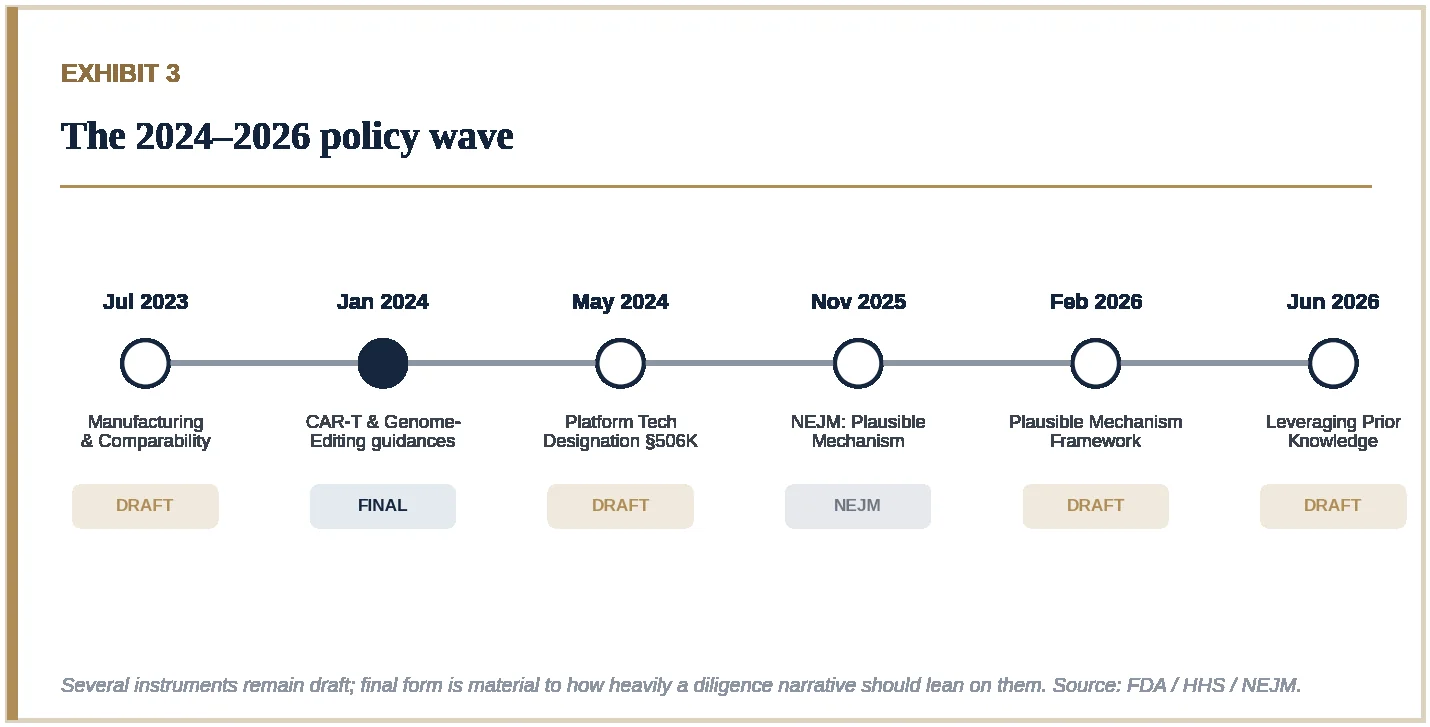
Exhibit 3. The 2024 to 2026 policy wave. Source: FDA, HHS, and NEJM; The Modeste Duncan Group analysis.
B.1 The Plausible Mechanism Framework for individualized therapies
In February 2026, FDA, jointly through CBER and CDER, issued draft guidance establishing a Plausible Mechanism Framework for individualized therapies that target specific genetic conditions with a known biological cause, where conventional randomized trials are infeasible.17, 18 Effectiveness may be supported by a scientifically validated mechanism of action rather than by large trials alone. The framework builds on a 2025 NEJM articulation by FDA leadership and was motivated by individualized in vivo editing successes.19, 25 For a rare-disease platform this is the period's most consequential development, because it offers a credible approval logic for the individualized and ultra-rare tail. As draft guidance, it should be treated as direction of travel, not a finalized pathway.
B.2 Leveraging Prior Knowledge in genome-editing development
In June 2026, FDA issued draft guidance on leveraging prior knowledge, both public and platform knowledge, across ex vivo and in vivo genome-editing programs. It describes how chemistry, manufacturing, and controls (CMC), nonclinical, and clinical knowledge may transfer to accelerate development, particularly for rare diseases.20 This is the regulatory recognition of platform amortization. One distinction must be preserved: platform, CMC, and delivery knowledge is amortizable, whereas per-locus on-target and off-target editing safety data generally is not.
B.3 Platform Technology Designation (§506K) and manufacturing reform
The Platform Technology Designation program, established by §506K under the 2022 PREVENT Pandemics Act and detailed in May 2024 draft guidance, lets a reproducible technology be designated. That expressly includes a nucleic acid sequence or an LNP delivery method incorporated in an approved product, so that later products can leverage prior data.9, 10 On the manufacturing side, CDER's FRAME initiative is building a framework for advanced, distributed, and point-of-care manufacturing.15, 16 The July 2023 comparability draft warns that a major change, or a new site, can render a product non-comparable and trigger a new IND.14 Because the process defines the product, comparability is the recurring gate that decentralized manufacturing must clear.
Part C · Potential Future Elements
What Would Have To Be True
The forward question is sharper than whether current law fits. It is what would have to change for an upstream, transplant-style classification to exist at all, one in which a genomic correction is governed as a procedure or an allocated input rather than regulated as a distributed product. Reproducing the transplant outcome requires reproducing its cause, which is non-manufacture (Exhibit 4).
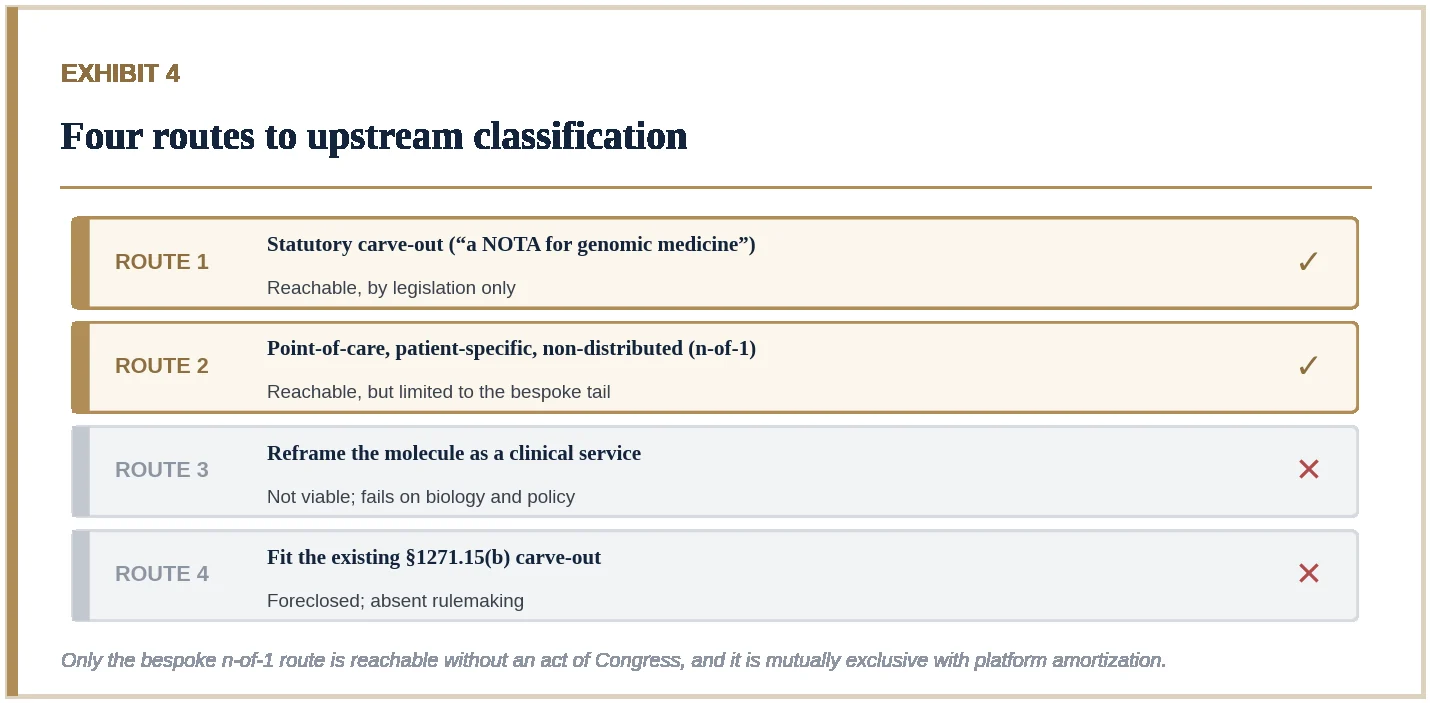
Exhibit 4. Four routes to upstream classification. Only two survive. Source: The Modeste Duncan Group analysis.
C.1 The routes, and the common preconditions
Two routes survive scrutiny. A statutory carve-out, a kind of NOTA for genomic medicine, is the only route that fits an industrialized platform, but it asks more than NOTA ever did, because NOTA never had to wave away manufacturing. The point-of-care, patient-specific route works only for the bespoke n-of-1 tail, and it is mutually exclusive with amortization. The service-reframe and §1271.15(b) routes are foreclosed. Across the surviving routes, the same preconditions recur:
• The manufactured, distributed article must either disappear, through point-of-care and patient-specific production, or be deemed irrelevant by statute. That is the entire basis of the transplant escape.
• A separate oversight home must exist, covering allocation, certified centers, registry, and surveillance. The operational layer never confers legal status. Only a statute does.
• Single-administration definitiveness must be demonstrated, not asserted. A finite re-treatment course remains a procedure. Open-ended re-dosing collapses back into chronic biologic.
• A precipitating policy problem must exist. The product-plus-commercial model cannot deliver cures for ultra-rare disease when risk-adjusted commercial value is deeply negative. That is the strongest substrate for a new public, non-commercial category.
C.2 The deepest obstacle, and the tension that cannot be dodged
Premarket review of manufactured articles exists because manufacturing carries class-wide risk. A bad batch, CMC drift, or an LNP-immunogenicity signal harms everyone who receives that lot. The transplant safety model never confronted this, because an organ's risks are per-unit. The emerging field consensus is a centralized control-site model that holds a master file and the application, with decentralized sites operating beneath it.23 That design lives inside the product regime rather than escaping it.
*The platform thesis and the upstream-classification thesis are in direct opposition. Reproducibility is the very property that makes the editor a class, and therefore a product.*
A sponsor cannot tell investors that a product is industrialized, platform-amortized, and reproducible, and at the same time tell regulators that the same product is unique, procured, and procedure-like. The upstream route is reachable only where the platform logic breaks down, at the n-of-1 personalization tail. For a committed multi-program platform, an upstream classification would require an act of Congress motivated by the market-failure argument. That opposition is not permanent, though. It holds only for as long as reproducibility must be re-proven, program by program, through a fresh product review. Part D asks what changes if reproducibility can instead be proven once and maintained continuously.
C.3 Reimbursement and access futures
Short of reclassification, the payment and access layers are where the most movement is realistically available. The CGT Access Model is the template for centrally negotiated, outcomes-based, multi-state payment, and it has an explicit pathway to extension.22 Annuity and milestone structures, episode and DRG bundling, and registry-linked outcomes contracts make a one-time curative correction financeable. The access infrastructure, meaning certified centers, a longitudinal registry, and long-term follow-up consistent with the fifteen-year horizon in FDA's genome-editing guidance,13 is at once the substrate for any future upstream regime and the credibility scaffold that outcomes-based payment requires. Building it is a no-regret move whether or not classification ever changes.
Part D · A Constructive Proposal
Toward a Regulated Category of Genomic Correction
Part C set a demanding bar. The upstream route needs an act of Congress, and any new category has to answer the reason premarket review of manufactured products exists at all, which is class-wide manufacturing risk. This part takes that bar seriously and asks a constructive question. What would have to be built for the answer to become credible, and what would the resulting system look like? Two developments make the question worth asking now. The assurance problem is being reshaped by technology, and the outcome the field is reaching for, a single molecular correction, can be described as one coherent system rather than a sequence of unrelated product reviews.
D.1 Technology changes the assurance question
Premarket product review answers a specific worry. A manufactured lot carries risk to everyone who receives it, and that risk is hard to see until the lot is made and tested. A cluster of technologies is changing how continuously that risk can be seen. Artificial intelligence models used to inform safety, efficacy or quality are now the subject of an FDA credibility framework, set out in draft guidance issued in January 2025 and non-binding at the time of writing.26 Digital twins, process analytical technology, and real-time release testing, developed under quality-by-design and the ICH Q13 continuous-manufacturing standard, let process consistency and comparability be monitored in line rather than inferred from a finished sample.27 Computational models can be submitted with a defined, risk-informed credibility assessment,28 and next-generation sequencing supports per-locus on-target and off-target safety evaluation.21 Together these tools point toward continuous, model-based assurance of the platform in place of a fresh product review for every program.29
| Technology | What it assures | Regulatory anchor |
|---|---|---|
| AI and machine-learning models | Model outputs bearing on safety, efficacy, and quality, under a risk-based credibility framework | FDA draft guidance, Jan. 2025 |
| Digital twins, PAT, real-time release | In-line process consistency and comparability across sites and lots | ICH Q13; FDA PAT and quality-by-design |
| In-silico computational modeling | Predictive robustness, verified and validated to a defined credibility level | FDA CM&S guidance (2023); ASME V&V40 |
| Next-generation sequencing | Per-locus on-target and off-target editing safety | FDA draft guidance (2026) |
| Longitudinal registry and mechanism evidence | Efficacy and durability, tracked over the follow-up horizon | CGT Access Model; genome-editing follow-up |
Two cautions belong with the promise. The tools have to reach regulatory-grade credibility before they can carry weight, which is the entire purpose of the FDA frameworks cited here, and per-locus editing safety stays specific to each target rather than amortizable across the platform. The claim is not that technology removes the need for oversight. It is that technology can shift much of that oversight from a periodic, retrospective product review to a continuous, prospective assurance system.
D.2 A proposed category of genomic correction
If continuous assurance can be demonstrated to a regulator's satisfaction, a coherent new category becomes describable. It would not pretend the molecule is unmanufactured. It would separate what is assured continuously from what is reviewed program by program (Exhibit 5).
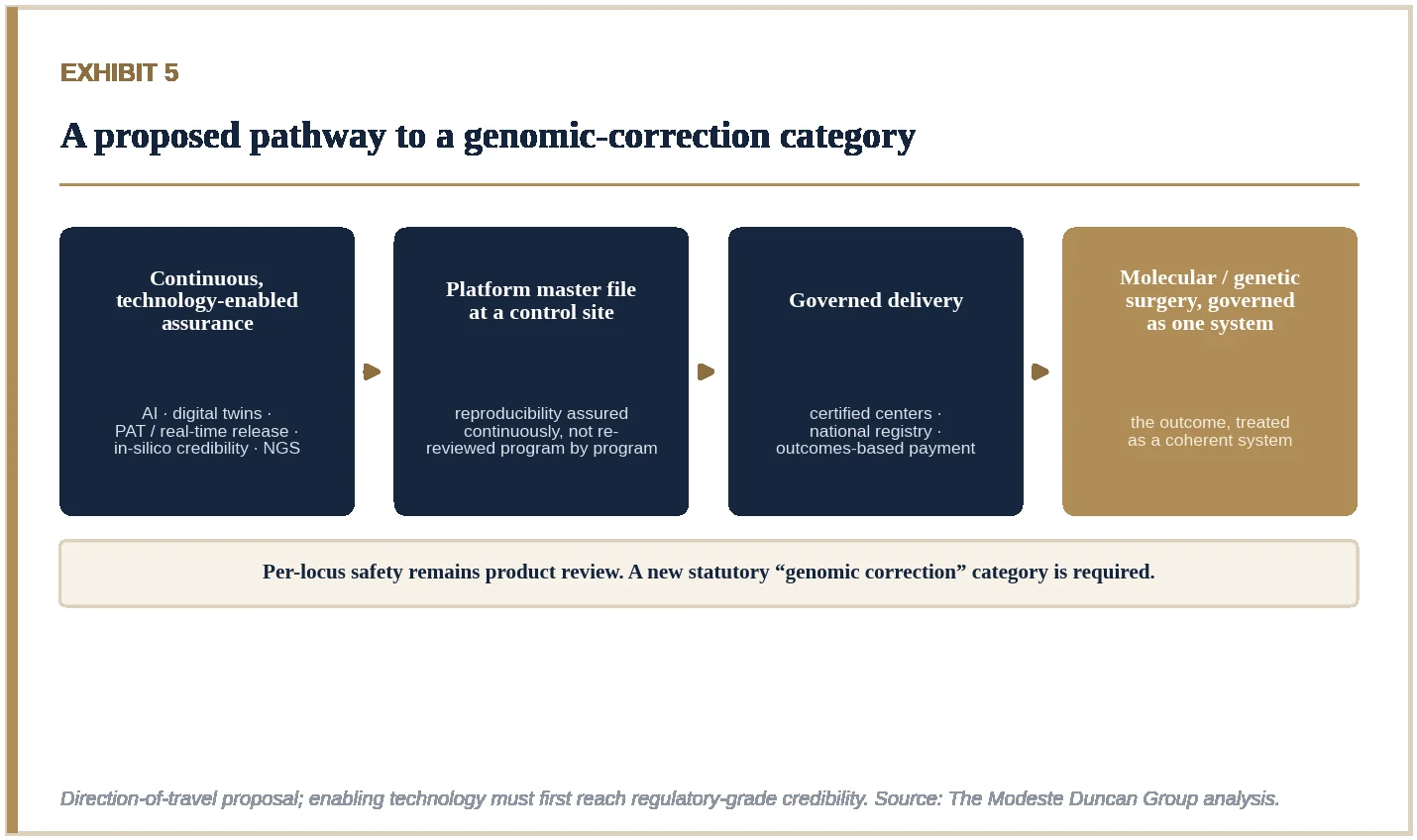
Exhibit 5. A proposed pathway to a genomic-correction category. Source: The Modeste Duncan Group analysis.
The building blocks are already visible in today's instruments:
• A platform master file at a control site. Reproducibility is assured continuously through the technologies above, rather than re-established in each program's dossier.
• Per-locus safety as product review. On-target and off-target editing safety is generated target by target and reviewed on its own.
• Governed delivery. Certified centers, a mandatory national registry, and long-term follow-up carry the procedure.
• Outcomes-based national payment. The CMS Cell and Gene Therapy Access Model is the working template, extended across the category.
• A statutory category that ties these together. This is the fleshed-out version of the NOTA-for-genomic-medicine route that Part C found to be the only one fitting an industrialized platform.
*The outcome the field calls molecular surgery becomes coherent only when the platform is assured continuously and the patient-specific correction is reviewed on its own. Technology is what makes the first half of that sentence possible.*
This is a long-horizon proposal. It requires legislation, and it requires the enabling technologies to be validated to a standard a regulator will accept for safety-critical use. Its value today is directional. Every element of the delivery, registry, and payment infrastructure is a no-regret investment under the current product regime. Each advance in continuous assurance shortens the distance between the biologic the law recognizes now and the governed system the field is trying to reach.
D.3 The guide-swap test
There is a sharper way to state where this is heading. In an industrialized editor, the delivery, the editor, and the manufacturing process are fixed; what changes from one program to the next is mostly the guide, the sequence that points the editor at a particular locus. The vision worth naming is regulatory parity between changing that guide and changing which organ a transplant center implants. Neither should start the approval over. Today, changing the guide triggers what amounts to a new product review. The question is what would make it routine.
Parity does not mean waving the new guide through. Off-target risk is sequence-specific: a new guide carries a new off-target profile that cannot be assumed away, which is why this paper has kept per-locus safety as product-specific work. But an organ change is not waved through either. It triggers tissue typing and a crossmatch, a standardized, pre-qualified, rapid check performed at the point of care rather than a fresh premarket approval. That is the right target for a guide change: not exemption, but a qualified molecular crossmatch, computational off-target prediction confirmed by next-generation sequencing,21 executed under the platform master file to a pre-agreed standard. Qualified in that way, changing the guide becomes a specification change within an approved platform rather than a new product (Exhibit 6).
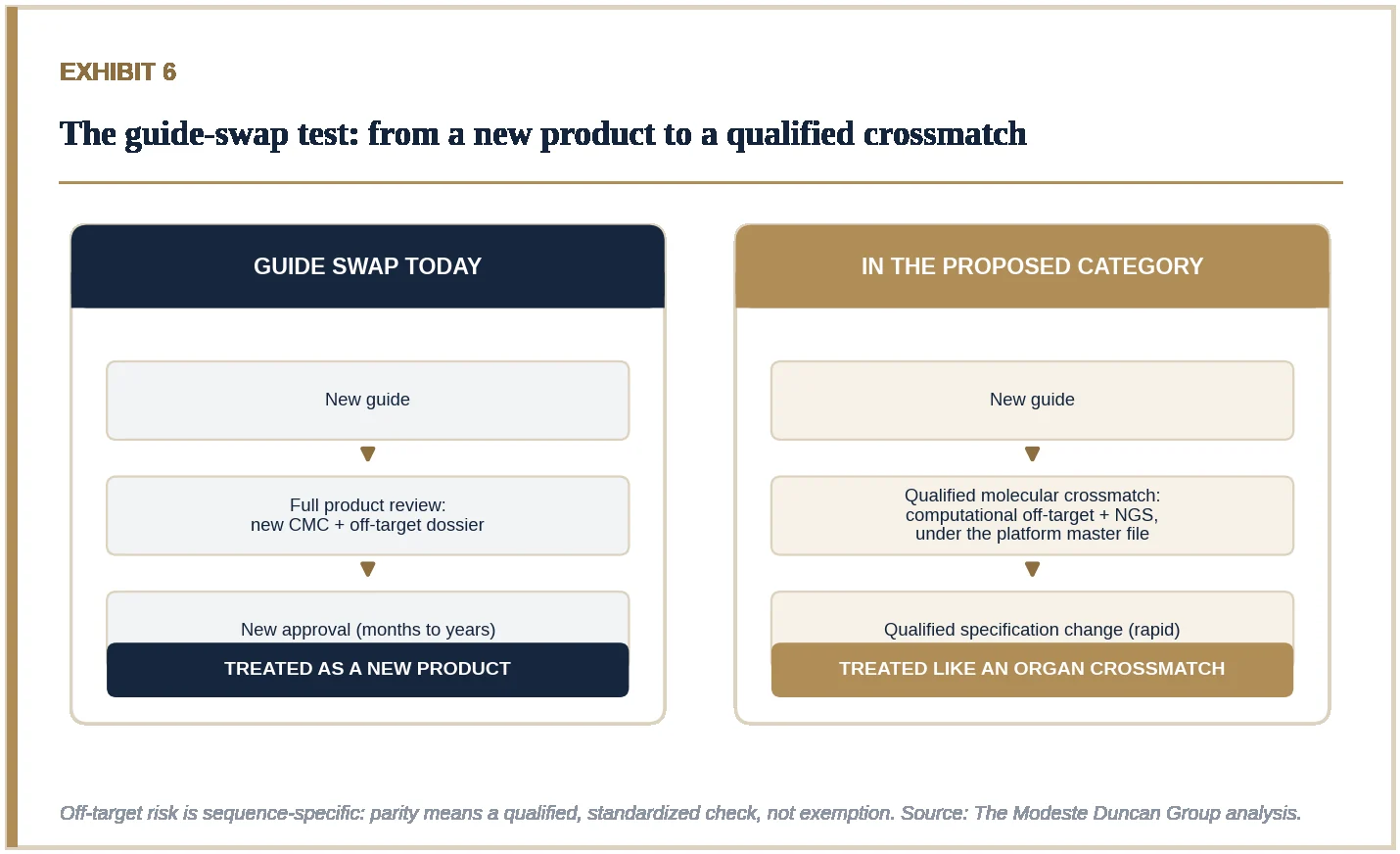
Exhibit 6. The guide-swap test: from a new product review to a qualified crossmatch. Source: The Modeste Duncan Group analysis.
The vision therefore has two halves, not one. The first is platform sameness, the continuous assurance of delivery, process, and analytics set out in D.1 and D.2. The second is per-guide sameness, the qualified crossmatch above. Both are required, and neither alone is enough. The place it arrives first is the individualized tail, where guide-swapping is most frequent and where the Plausible Mechanism Framework and the §561 pathway already point toward mechanism-based, per-patient approval.17, 18
*A real category will have arrived when changing the guide is treated like changing the organ: not exempt from review, but qualified for it. The platform is assured once and maintained; each new guide clears a standardized crossmatch rather than a new approval.*
4Synthesis: An Integrated Operating Model
Woven together, the layers give a thesis that survives a skeptical scientific, regulatory, and financial reviewer (Exhibit 7).
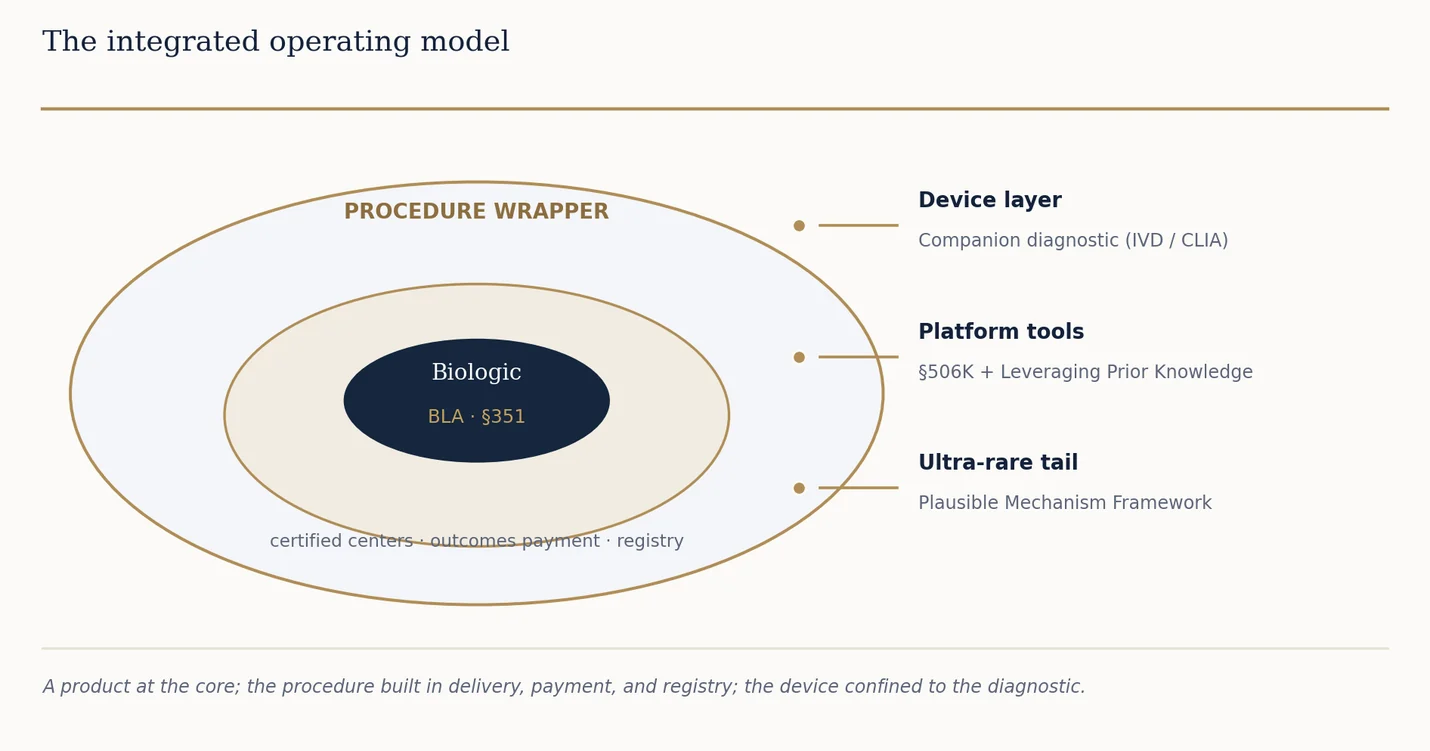
Exhibit 7. The integrated operating model. Source: The Modeste Duncan Group analysis.
• At the center is a biologic. The editor, guide, and LNP form a §351 product approved by BLA. State it first, without hedging.
• The procedure lives in the wrapper. Certified centers, episode or outcomes-based payment, patient matching, and a longitudinal registry deliver and finance the therapy as a procedure, with no claim that FDA reclassifies the molecule.
• The only device is the diagnostic. The variant-amenability companion diagnostic is the formal compatibility test, device-regulated and co-developed with the therapy.
• Platform tools carry the amortization. Platform Technology Designation and the Leveraging Prior Knowledge guidance transfer shared CMC, delivery, and clinical knowledge across programs, while per-locus safety data is generated program by program.
• The Plausible Mechanism Framework serves the tail. For the individualized and ultra-rare end of the portfolio, mechanism-based approval offers a credible path.
From practice. The author spent nearly thirty years as a senior biopharmaceutical executive, with executive accountability for programs and portfolios cumulatively exceeding \$7 billion, the first approved self-amplifying mRNA vaccine, and partnerships across CEPI, GAVI, sovereign governments, and industry. The classification, platform, and manufacturing choices set out here are the ones that determine how programs actually move.
5Conclusion and Verification Note
The path to developing, approving, paying for, and accessing genomic cures is not a single breakthrough. It is a stack: a settled product-classification foundation, an existing procedure-style delivery and payment architecture, a fast-moving wave of platform and individualized-therapy policy, and a contested frontier of potential upstream change that is reachable only at the margins and only by statute. The defensible posture is to build on the first three layers, where the precedents are real and the instruments are in hand, and to treat the fourth as a long-horizon policy argument anchored in the market-failure case. Part D adds a technological complement to that argument: as continuous-assurance tools mature, the case for a new category becomes an engineering question as much as a policy one.
Verification note. The structural law cited here, including NOTA, the 351 and 361 framework, §1271.15(b), §561, §506K, and the biologic and device line, is settled. The actively moving elements, including the Plausible Mechanism Framework, the Leveraging Prior Knowledge guidance, the genome-editing NGS safety guidance, and the FRAME distributed-manufacturing workstream, are draft or evolving as of June 2026.
- Before any conclusion is relied upon in diligence or external materials, the current status of these drafts and of the CGT Access Model's expansion should be re-confirmed against primary FDA, HHS, and CMS sources, and classification conclusions confirmed with qualified counsel.
Appendices
Appendix A · The Regulatory Escalator
Where each modality sits is determined by manipulation, use, and manufacture, not by curative intent or delivery setting. A genomic editor sits on the top rung.
| Rung | Character of the article | Governing regime | Representative examples |
|---|---|---|---|
| Practice of medicine | Patient's own material, moved in one procedure; minimally manipulated; homologous | §1271.15(b); state practice; FDA approves little or nothing | Autologous skin graft; conventional organ transplant |
| 361 HCT/P | Donor material; minimally manipulated; homologous; no systemic effect | 21 C.F.R. Part 1271; safety only, no premarket approval | Allograft tissue; donor gametes and embryos (IVF, plus CLIA and FCSRCA) |
| Device | Acts by physical or structural means; not metabolized | 510(k) or PMA; IVD and CLIA for diagnostics | Intraocular lens; acellular scaffolds; companion diagnostic; SaMD |
| 351 biologic | Manufactured, characterized, batch-released; more than minimal manipulation; systemic or genetic | IND and BLA under PHS Act §351; full premarket CMC review (CBER) | CAR-T; Casgevy and Lyfgenia; engineered tissue or xenograft; in vivo base or prime editor |
Appendix B · Analog Mapping
Each analog supports specific layers of the treated-as-a-procedure claim. None makes the editor itself anything other than a biologic.
| Analog | What it shows | Layers supported | Limitation |
|---|---|---|---|
| Organ transplant | A biological intervention can be governed, paid, and delivered entirely as a procedure | Concept; delivery; payment; registry | Non-manufactured; no classification read-across |
| CAR-T | A manufactured biologic delivered as a certified-center episode with outcomes contracts | Classification (as product); delivery; payment | Heavy ex vivo apparatus; not re-dosable |
| Casgevy / Lyfgenia | Gene editing reimbursed and delivered as a transplant-style episode via the CGT Access Model | Classification (as product); delivery; payment | Ex vivo; one and done; bespoke CMS deal |
| Cataract / IOL | Approved article plus device-regulated matching plus procedure delivery plus one-time correction | Concept; delivery; payment; matching | IOL is a device (optical MOA), not a biologic |
| IVF | Procedure plus CLIA lab oversight plus outcomes reporting, outside FDA premarket approval | Delivery; lab quality; registry and outcomes | Safety-only tier earned by minimal manipulation |
Appendix C · References
Statutory and regulatory citations reflect settled U.S. law. FDA, HHS, and CMS documents were confirmed against primary sources as of June 2026. Draft guidances are identified as such and remain subject to change. Citations were verified to September 2026; where a source postdates the paper, the later status is given.
1. National Organ Transplant Act of 1984, Pub. L. No. 98-507; 42 U.S.C. §273 et seq.
2. Public Health Service Act §351, 42 U.S.C. §262 (biologics licensure; Biologics License Application).
3. Federal Food, Drug, and Cosmetic Act §201(g) and (h), 21 U.S.C. §321(g) and (h) (definitions of drug and device).
4. 21 C.F.R. Part 1271 (HCT/Ps); §1271.10 (criteria for 361 regulation) and §1271.15(b) (same-surgical-procedure exception).
5. FD&C Act §503A, 21 U.S.C. §353a, and §503B, 21 U.S.C. §353b (pharmacy compounding and outsourcing facilities).
6. FDA, “Compounding and the FDA: Questions and Answers.” Biological products are ineligible for §503A and §503B compounding exemptions.
7. FD&C Act §561, 21 U.S.C. §360bbb (expanded access and individualized pathway); n-of-1 antisense oligonucleotide precedent,
NEJM (2019).
8. FD&C Act §506(g), Regenerative Medicine Advanced Therapy designation, added by the 21st Century Cures Act, Pub. L. No. 114-255, §3033 (2016).
9. FD&C Act §506K, Platform Technology Designation, added by the PREVENT Pandemics Act (2022), enacted within the Consolidated Appropriations Act, 2023, Pub. L. No. 117-328.
10. FDA, “Platform Technology Designation Program for Drug Development; Draft Guidance for Industry” (May 2024), Docket FDA-2024-D-1829; 89 Fed. Reg. 46407.
11. FD&C Act §506L, Advanced Manufacturing Technologies Designation Program, added by FDORA §3213; FDA AMT Designation Program, CY2025 Report to Congress.
12. FDA, “Considerations for the Development of Chimeric Antigen Receptor (CAR) T Cell Products; Guidance for Industry” (final, January 2024), Docket FDA-2021-D-0404; Federal Register notice January 30, 2024.
13. FDA, “Human Gene Therapy Products Incorporating Human Genome Editing; Guidance for Industry” (final, Jan. 2024), Docket FDA-2021-D-0398 (long-term follow-up up to fifteen years).
14. FDA, “Manufacturing Changes and Comparability for Human Cellular and Gene Therapy Products; Draft Guidance” (July 2023), Docket FDA-2023-D-2436; 88 Fed. Reg. 45222 (July 14, 2023); comment period extended to November 13, 2023.
15. FDA CDER, “Framework for Regulatory Advanced Manufacturing Evaluation (FRAME) Initiative.”
16. FDA CDER and CBER, “Distributed Manufacturing and Point-of-Care Manufacturing of Drugs: Discussion Paper” (2022); “Distributed Manufacturing of Drugs: Stakeholder Feedback and Action Plan” (Nov. 2023).
17. FDA, “Considerations for the Use of the Plausible Mechanism Framework to Develop Individualized Therapies …; Draft Guidance for Industry” (Feb. 2026).
18. HHS and FDA, Press Release, “FDA Launches Framework for Accelerating Development of Individualized Therapies for Ultra-Rare Diseases” (Feb. 23, 2026).
19. Prasad V, Makary MA. “FDA’s New Plausible Mechanism Pathway.”
New England Journal of Medicine, published online November 12, 2025; 393(23). doi:10.1056/NEJMsb2512695 (Sounding Board). Note that both authors departed FDA in May 2026; at a May 2026 CDER and CBER workshop the agency clarified that the framework operates through existing pathways rather than creating a new one.
20. FDA, “Leveraging Prior Knowledge in the Development of Human Gene Therapy Products Incorporating Genome Editing; Draft Guidance” (June 3, 2026; comments through Sept. 1, 2026).
21. FDA, “Safety Assessment of Genome Editing in Human Gene Therapy Products Using Next-Generation Sequencing; Draft Guidance” (2026).
22. CMS Innovation Center, “Cell and Gene Therapy Access Model,” FAQs; HHS Press Release, “CMS Expands Access to Lifesaving Gene Therapies Through Innovative State Agreements” (2025).
23. Frontiers in Medicine, “Implementation of a Quality Management System for Decentralized Manufacturing of Cell and Gene Therapy Products” (2025); UK MHRA point-of-care framework.
24. Regulation (EC) No 1394/2007 on Advanced Therapy Medicinal Products, Art. 28 (EU hospital exemption); Fertility Clinic Success Rate and Certification Act of 1992, Pub. L. No. 102-493; Clinical Laboratory Improvement Amendments of 1988, 42 U.S.C. §263a.
25. Musunuru K, Grandinette SA, Wang X, et al. “Patient-Specific In Vivo Gene Editing to Treat a Rare Genetic Disease.” New England Journal of Medicine 2025 Jun 12;392(22):2235–2243. doi:10.1056/NEJMoa2504747. Epub 2025 May 15. PMID 40373211. The “Baby KJ” case.
26. FDA, “Considerations for the Use of Artificial Intelligence to Support Regulatory Decision-Making for Drug and Biological Products,” Draft Guidance for Industry (Jan. 7, 2025); risk-based credibility assessment framework for AI models bearing on safety, efficacy, or quality.
27. ICH Q13, “Continuous Manufacturing of Drug Substances and Drug Products”; FDA, “PAT — A Framework for Innovative Pharmaceutical Development, Manufacturing, and Quality Assurance” (2004); ICH Q8–Q11 (Quality by Design).
28. FDA / CDRH, “Assessing the Credibility of Computational Modeling and Simulation in Medical Device Submissions” (final, November 2023), Docket FDA-2021-D-0980, CDRH; applying ASME V&V 40-2018.
29. On digital twins and model-based assurance in biomanufacturing, see reviews of digital-twin applications from process development to continuous manufacturing (2024–2025). Illustrative literature, not regulatory guidance.
30. On payment design for durable one-time therapies, see MIT NEWDIGS FoCUS, “Paying for Cures”; ICER and NEWDIGS, “Managing the Challenges of Paying for Gene Therapy” (2024); and the Duke-Margolis Health Policy Center cell and gene therapy work. This paper treats the payment mechanics as well established and focuses on classification and manufacturing assurance.
Abbreviations and Key Terms
Common abbreviations used in this paper. Key terms are also defined at first use in the text.
| AAV | Adeno-associated virus (a viral delivery vector) | IVD | In vitro diagnostic |
|---|---|---|---|
| ATMP | Advanced Therapy Medicinal Product (EU) | LNP | Lipid nanoparticle (delivery vehicle) |
| BLA | Biologics License Application | LTFU | Long-term follow-up |
| CBER | Center for Biologics Evaluation and Research (FDA) | MOA | Mechanism of action |
| CDER | Center for Drug Evaluation and Research (FDA) | NGS | Next-generation sequencing |
| CGT | Cell and gene therapy | NOTA | National Organ Transplant Act (1984) |
| CLIA | Clinical Laboratory Improvement Amendments | OPTN | Organ Procurement and Transplantation Network |
| CM&S | Computational modeling and simulation | PAT | Process analytical technology |
| CMC | Chemistry, manufacturing, and controls | PBC | Public benefit corporation |
| CMS | Centers for Medicare & Medicaid Services | PHS Act | Public Health Service Act |
| DRG | Diagnosis-related group (hospital payment) | PMA | Premarket approval (device pathway) |
| FCSRCA | Fertility Clinic Success Rate and Certification Act | QbD | Quality by design |
| FDA | Food and Drug Administration | RMAT | Regenerative Medicine Advanced Therapy |
| FRAME | Framework for Regulatory Advanced Mfg. Evaluation (FDA) | SaMD | Software as a medical device |
| HCT/P | Human cells, tissues, and cellular/tissue-based products | UNOS | United Network for Organ Sharing |
| HHS | Dept. of Health and Human Services | §351 / §361 | PHS Act biologic / Part 1271 tissue tiers |
| HRSA | Health Resources and Services Administration | §506K | Platform Technology Designation |
| ICH | International Council for Harmonisation | §561 | Expanded-access / individualized pathway |
| IND | Investigational New Drug application | §1271.15(b) | Same-surgical-procedure exception |
