Executive Summary
In many rare-disease financial models, one line item does outsized damage: the priority review voucher, entered at a value that can move a program from unfundable to attractive. This paper argues that the most defensible base-case value for a voucher is zero, and that a program designed to clear its bar without one is stronger, more fundable, and more durable.
The voucher still has value. The argument is about where that value belongs in a model. It belongs in a clearly separated upside scenario, not in the base case. The voucher is only the clearest example of a wider class. Any input whose existence and price depend on a policy that can change, whether a voucher, a tax credit, a grant, or a subsidy, is a poor foundation for a base case. And the deeper point is structural. If a program only works with the voucher, it is not yet a fundable program. It is a bet on legislation, and the better response is usually a different capital structure rather than a more optimistic forecast. That makes this short paper an entry point to a larger question, the design of the capital structure itself, which the companion papers take up.
*A voucher is not an asset the program controls. It is a policy-contingent payment, and a model that treats it as a receivable will not survive a careful reader.*
I have sat on both sides of this line: building the case for a rare-disease program and reading someone else's. A voucher carried in the base case is the fastest way I know to lose a room, because the people across the table have seen the same line in every deck that year and they discount the whole model once they find it.
1The Question, Stated Precisely
The question is not whether a priority review voucher has value. It plainly can. The question is what value a disciplined base case should assign it before the program is funded, when its existence, its eligibility, and its resale price at the moment of award all sit outside the developer's control. Two answers are common. One sets the base case to a probability-weighted expected value. The other sets the base case to zero and moves the expected value into an explicit upside scenario. This paper defends the second convention, on grounds of both discipline and credibility.
Part A · The Instrument
What a Priority Review Voucher Actually Is
A rare-pediatric-disease voucher is awarded to a sponsor that wins approval of a drug carrying rare-pediatric-disease designation. The voucher can be redeemed to shorten FDA review of a later application by roughly four months. It can also be sold to another company.1 Since 2012 the program has produced more than 400 designations and awarded more than fifty vouchers, and it has helped fund development in an area the market underserves.4 The point that follows is narrow. The market for the voucher is thin, and its value is hard to predict.
A.1 The secondary market is thin and headline-driven
Of the vouchers granted between 2020 and 2024, fewer than half were publicly sold. Across the program's life, disclosed sale prices have ranged from \$67.5 million to a \$350 million record, and they have moved with the program's fortunes in Congress (Exhibit 1).3 A value that varies several-fold on policy news is difficult to underwrite, however real it is when it arrives.
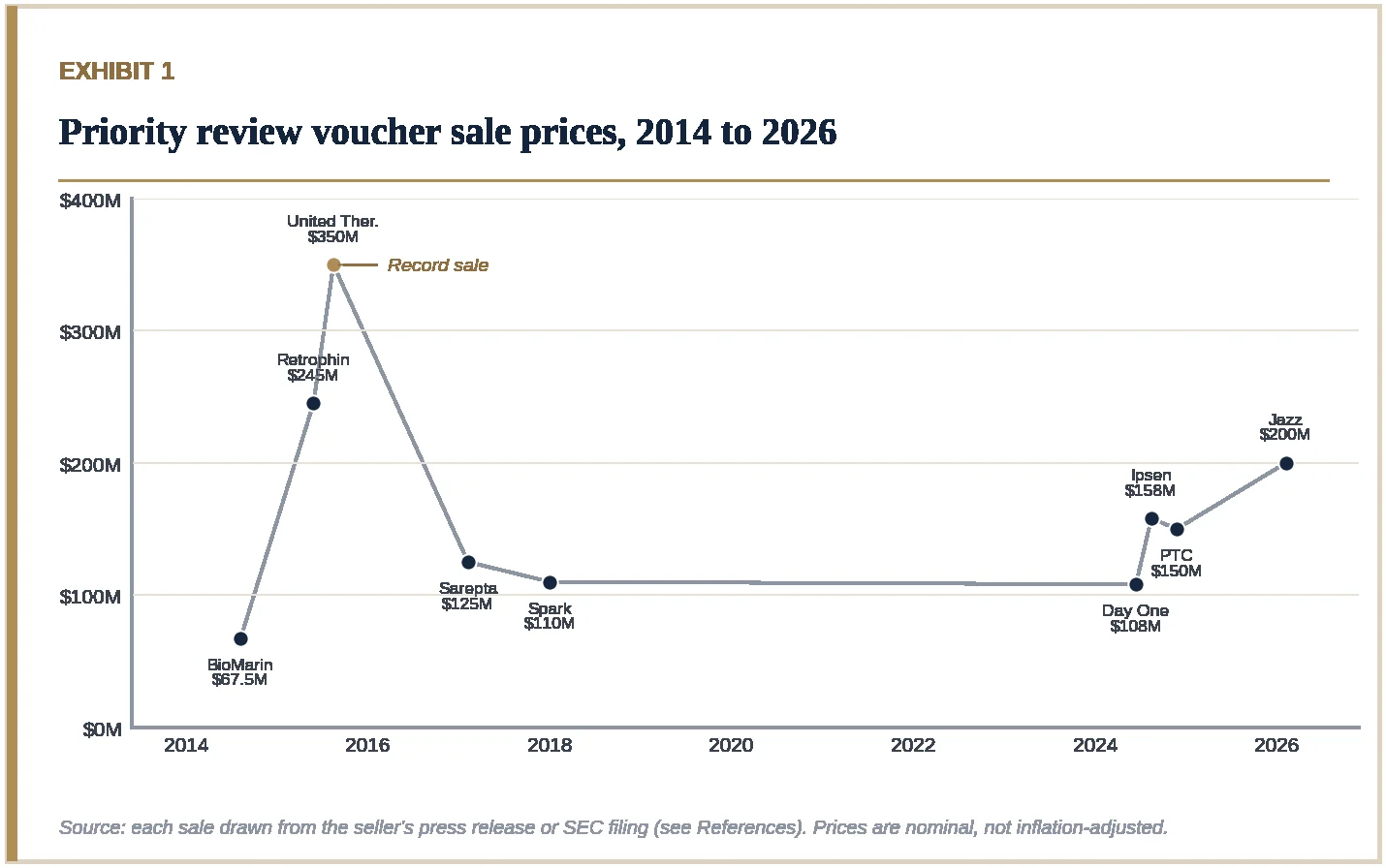
Exhibit 1. Priority review voucher sale prices, 2014 to 2026. Each sale is drawn from the seller's press release or SEC filing; see References.
A.2 A creature of appropriations, not an entitlement
The program that generates most vouchers is not a permanent entitlement. Congress created it in 2012, reauthorized it twice, allowed it to lapse for new designations after September 30, 2024, and reauthorized it again in 2026, this time through September 30, 2029 (Exhibit 2).1 Its status at any future award date depends on legislation that has already lapsed once. The 2029 reauthorization is welcome, and it does not change the modeling discipline. A value that Congress can grant, let lapse, and restore is precisely the kind of value a base case should not lean on.
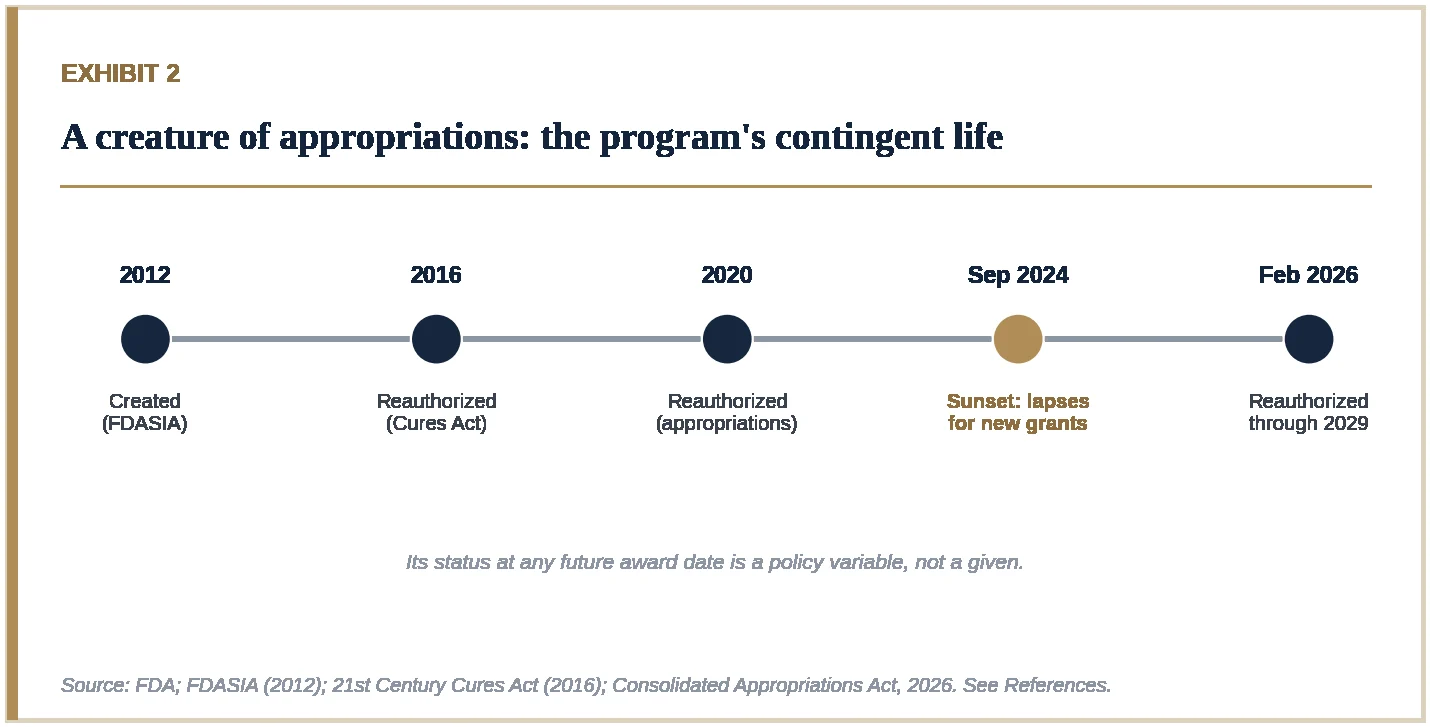
Exhibit 2. A creature of appropriations: the program's contingent life. Source: FDA; FDASIA (2012); 21st Century Cures Act (2016); Consolidated Appropriations Act, 2026; see References.
The Government Accountability Office, reviewing the incentive, found only limited evidence that it changed development decisions.2 That does not make the program worthless to patients or to sponsors. It does mean a developer should treat the voucher as a possible benefit, not a dependable one.
Part B · The Argument for a \$0 Base Case
The Argument for a \$0 Base Case
Setting the base-case voucher value to zero is a convention, not a prediction that the true expected value is zero. It rests on three disciplines:
• Model what you control. A base case should rest on inputs the team can influence: the science, the process, the regulatory path, the cost structure. The voucher meets none of these tests, so it does not belong in the foundation of the model.
• Separate the thesis from the upside. A durable program has a clear reason to work that does not depend on its most fragile input. Requiring viability at a voucher value of zero isolates that reason. If the program clears the bar, the voucher becomes upside rather than support.
• Anticipate the diligence question. A serious funder will discount the voucher independently. Doing so first, in the open, reads as rigor rather than weakness.
B.1 The category error
The mistake is to treat a policy-contingent payment as a contractual receivable. The cost is twofold. The first is a direct overstatement of value. The second is more damaging. A model that leans on a lapsed incentive tells a diligence team that the developer optimized the spreadsheet rather than tested the business. Once a reviewer notices it, it colors how they read every other assumption.
B.2 Base case versus upside
The remedy is not to ignore the voucher. It is to place it correctly. The base case has to clear its bar at a voucher value of zero. The voucher then lives in a separate, probability-weighted upside scenario, with the probability tied to the statutory status of the program at the expected award date and to a realistic secondary-market price (Exhibit 3). This is where an expected-value estimate belongs, and where a sophisticated reader expects to find it.
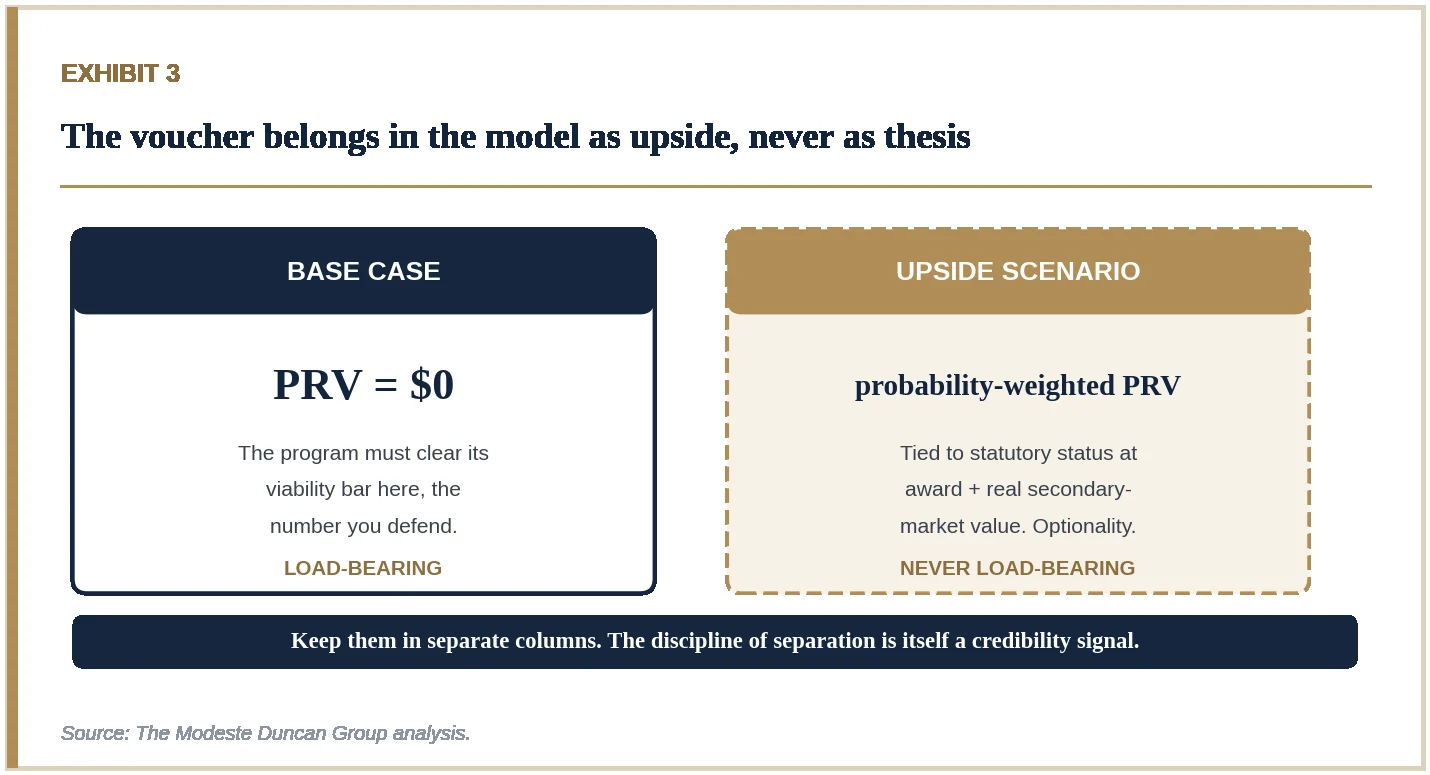
Exhibit 3. The voucher belongs in the model as upside, not as thesis. Source: The Modeste Duncan Group analysis.
*The sentence that builds the most credibility is simple: we model the voucher at zero, and the program still clears our bar.*
Part C · The Structural Consequence
The Voucher Question Is a Capital-Structure Question
When a program only works with the voucher, the instinct is to defend the voucher assumption. A more useful response is to ask what the model is saying about how the program should be financed. Often the answer is that it should not be a return-seeking venture at all.
A cure for a small population, with a high upfront cost and a single-administration model, can carry a deeply negative risk-adjusted net present value under conventional financing.6 That is not a verdict that the work should not happen. It is a signal about the capital the work requires. That capital is philanthropic, catalytic and mission-first capital, with commercial optionality layered on top through an appropriate vehicle such as a foundation paired with a public benefit corporation and reversionary IP covenants (Exhibit 4).
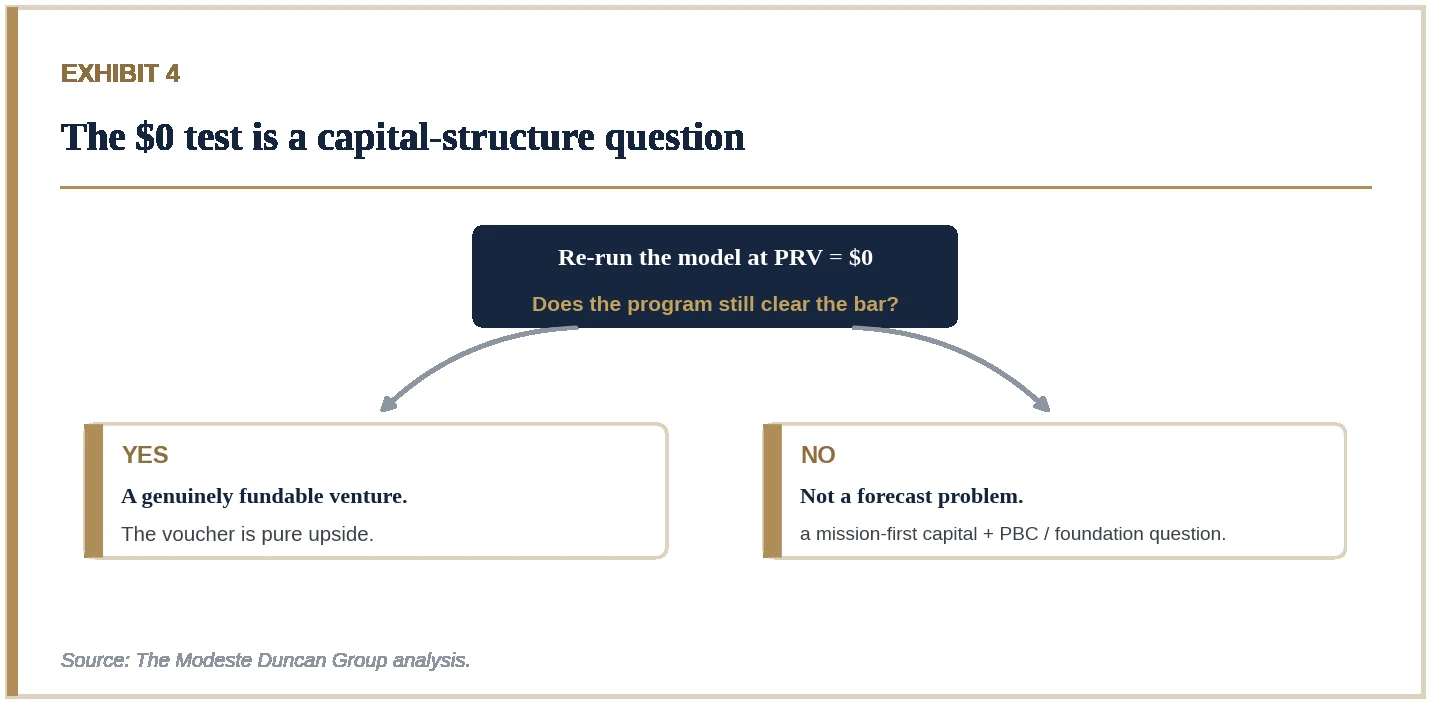
Exhibit 4. The \$0 test as a capital-structure question. Source: The Modeste Duncan Group analysis.
The cautionary evidence is real. Gene therapies have been approved, shown to work, and then withdrawn because no workable payment model existed.5 No amount of voucher optimism changes those economics. It only hides them. Placed correctly, the voucher does what it was meant to do. It accelerates a mission that was already solvent without it.
From practice. TMDG's advisory work centers on entity design and capital structure for mission-first programs. The author has led portfolio, development, and partnership decisions with executive accountability for programs and portfolios cumulatively exceeding \$7 billion. The recurring lesson is that when a model only clears its bar with a contingent incentive, the more productive response is to change the structure rather than defend the forecast.
2Synthesis: Modeling the Voucher Correctly
A defensible treatment is straightforward, and it is as much about communication as about arithmetic:
• Base case: voucher value of zero. The program must clear its viability bar here. This is the number you defend in diligence.
• Upside scenario or scenarios. The voucher at a probability-weighted value, with the probability tied to statutory status at the expected award date and to a realistic secondary-market price. Show the work on both inputs.
• Do not blend the upside into the base case. Keep them in separate columns. The separation is itself a signal of discipline.
• State the assumption in the narrative, not only in the spreadsheet: we assume no voucher value in our base case.
3Conclusion and Verification Note
Modeling the voucher at zero is not a concession. It is a design choice. A program that clears its bar without the voucher is one a serious investor can underwrite. And when a program does not clear that bar, the exercise has already done its most useful work. It shows that the program was never suited to ordinary return-seeking capital, and it points to the mission-first structure the program needed in the first place.
Verification note. The program's statutory history, including its creation in 2012, its lapse after September 30, 2024, and its reauthorization through September 30, 2029, and the transaction values cited here were confirmed against FDA, GAO, Congressional, and company disclosures as of June 2026. Secondary-market prices are volatile and should be re-confirmed at the time of any modeling exercise. Capital-structure conclusions should be confirmed with qualified counsel and financial advisors.
Appendices
Appendix A · PRV Transaction Ledger
Disclosed priority review voucher sales. Each is a public transaction. Together they describe a thin, volatile market that cannot support a load-bearing base-case assumption.
| Year | Seller | Buyer | Reported price |
|---|---|---|---|
| 2014 | BioMarin | Regeneron / Sanofi | \$67.5M |
| 2015 | Retrophin | Sanofi | \$245M |
| 2015 | United Therapeutics | AbbVie | \$350M |
| 2017 | Sarepta | Gilead | \$125M |
| 2018 | Spark Therapeutics | Jazz | \$110M |
| 2024 | Day One Biopharma | Undisclosed | \$108M |
| 2024 | Ipsen | Large pharmaceutical co. | \$158M |
| 2024 | PTC Therapeutics | Undisclosed | \$150M |
| 2026 | Jazz Pharmaceuticals | Undisclosed | \$200M |
Of the vouchers granted between 2020 and 2024, fewer than half were publicly sold. Each transaction above is drawn from the seller's press release or SEC filing; voucher-issuance counts are from FDA records. See References.
Appendix B · Program Timeline
The statutory life of the rare-pediatric-disease priority review voucher program.
| Date | Action |
|---|---|
| 2012 | Program created by the FDA Safety and Innovation Act (FDASIA §908) |
| 2016 | Reauthorized in connection with the 21st Century Cures Act |
| 2020 | Reauthorized via appropriations |
| Sep 30, 2024 | Sunset. Program lapses for new rare-pediatric-disease designations |
| Feb 2026 | Reauthorized through Sept. 30, 2029 (Consolidated Appropriations Act, 2026) |
References
Statutory and program citations reflect settled or currently effective U.S. law and policy as of June 2026. Secondary-market transaction values reflect company and regulator disclosures and are volatile; they should be re-confirmed against primary sources before any modeling use. Citations were verified to September 2026; where a source postdates the paper, the later status is given.
1. Rare Pediatric Disease Priority Review Voucher program: created by the FDA Safety and Innovation Act (FDASIA §908, 2012), which added §529 to the FD&C Act, 21 U.S.C. §360ff; redeemable to shorten FDA review by roughly four months, or transferable; lapsed for new designations after Sept. 30, 2024; reauthorized through Sept. 30, 2029 by the Consolidated Appropriations Act, 2026. U.S. FDA, Rare Pediatric Disease Designation and Priority Review Voucher Programs.
2. U.S. Government Accountability Office, Drug Development: FDA’s Priority Review Voucher Programs (GAO-20-251, January 2020).
3. Priority review voucher sales, each from the seller's disclosure: BioMarin (press release, July 30, 2014; \$67.5M; buyer Regeneron / Sanofi); Retrophin (May 2015; \$245M; Sanofi); United Therapeutics (PRNewswire, Aug. 2015; \$350M record; AbbVie; voucher from Unituxin); Sarepta (Feb. 2017; \$125M; Gilead); Spark Therapeutics (May 2018; \$110M; Jazz); Day One Biopharmaceuticals (Form 8-K and press release, May 30, 2024; \$108M; undisclosed buyer; voucher from OJEMDA); Ipsen (press release, Aug. 2024; \$158M); PTC Therapeutics (SEC Form 8-K, Nov. 2024; \$150M); Jazz Pharmaceuticals (disclosed January 2026 at the J.P. Morgan Healthcare Conference, agreement executed 2025; \$200M; undisclosed buyer; voucher from Modeyso; highest price since 2016). Voucher-issuance counts from FDA records.
4. Miller KL et al. “Analysis of the first ten years of FDA's rare pediatric disease priority review voucher program.” Orphanet Journal of Rare Diseases / PMC (2024): more than 400 designations and more than 50 vouchers awarded.
5. bluebird bio withdrawal of Zynteglo and Skysona from the European market (2021) for want of a workable reimbursement model. BioPharma Dive; bluebird bio Form 8-K.
6. DiMasi JA, Grabowski HG, Hansen RW. “Innovation in the pharmaceutical industry: New estimates of R&D costs.” Journal of Health Economics 2016 May;47:20–33. doi:10.1016/j.jhealeco.2016.01.012. PMID
- The estimate is debated; the argument here depends only on a large, largely fixed cost meeting a small eligible population.
Abbreviations and Key Terms
Common abbreviations used in this paper.
| FDA | Food and Drug Administration | PBC | Public benefit corporation |
|---|---|---|---|
| FDASIA | FDA Safety and Innovation Act (2012) | PRV | Priority review voucher |
| GAO | U.S. Government Accountability Office | SEC | Securities and Exchange Commission |
| IP | Intellectual property | §908 | Rare pediatric disease PRV provision |
| NPV | Net present value | CGT | Cell and gene therapy |
