Executive Summary
For a growing set of diseases, the science is tractable but the business case is not. The gene is known. The mechanism is understood. The editor works in the relevant models, and delivery is solved well enough to file an IND. The program still does not get built. The eligible population is too small to repay a conventional development effort at any price payers will accept. Estimates differ by source, but of the roughly 7,000 recognized rare diseases, only a small share have any FDA-approved therapy.
The market leaves these diseases undeveloped and treats that outcome as an economic law.12 It is not a law. It is the result of one default structure: a single company, a single product, a single price, a single payer, a single balance sheet. That structure was built for common diseases. Applied to a population of a few hundred patients, it returns a negative verdict. A different structure can return a different verdict. Several of the most visible commercial failures in genetic medicine were failures of structure rather than of science.
*“Uneconomic” is rarely a property of the disease. It is usually a property of the structure chosen to develop it.*
This paper makes two moves. First, it explains why the default structure fails. Development cost is largely fixed, revenue scales with a small denominator, and the usual escape routes are closed. Second, and this is where it departs from the existing financing literature, it argues that the payment mechanics are by now well mapped by MIT NEWDIGS, ICER, and Duke-Margolis.11 The hard part of an ultra-rare structure is the governance and intellectual-property architecture that makes a blended, mission-first structure fundable and durable. Knowing how to pay for a one-time cure is close to a solved problem. Knowing how to hold mission and commerce in one structure, so that it survives related-party scrutiny and a change of control, is not. That is the problem this paper is built around.
I have watched programs with tractable science stop at exactly this point, and the reason is rarely scientific. The team runs out of a structure that lets the work continue, which is a design problem rather than a research problem, and design problems have answers.
1The Question, Stated Precisely
The reflex question is how to price a therapy for three hundred patients. It has no good answer, which is why the field keeps producing weak ones. Raise the price and you meet the payer and political ceiling, and you undermine access, which was the goal. Lower the price and you cannot recover the cost. The question itself is the problem. A more useful question is structural, and it has two parts. Can the marginal cost of a three-hundred-patient program approach the marginal cost of a shared platform? And can a one-time, uncertain payment be converted into something a balance sheet can underwrite? The rest of this paper follows from taking those two questions seriously.
Part A · The Diagnosis
Fixed Costs Meet a Small Denominator
Most of the cost of developing a therapy does not depend on how many patients will receive it. The IND package, the toxicology program, the good-manufacturing-practice (GMP) batches, the trial infrastructure, the filing, and inspection readiness change little whether prevalence is fifty thousand or three hundred. Published estimates of the fully capitalized cost of bringing one new drug to approval vary widely, from several hundred million dollars to about \$2.6 billion, and the higher figures are contested.1 The exact number is not the point. Even at the low end, the cost is large and largely fixed, while revenue scales with the number of patients. Below some population, risk-adjusted net present value is negative at any price the system will bear (Exhibit 1).
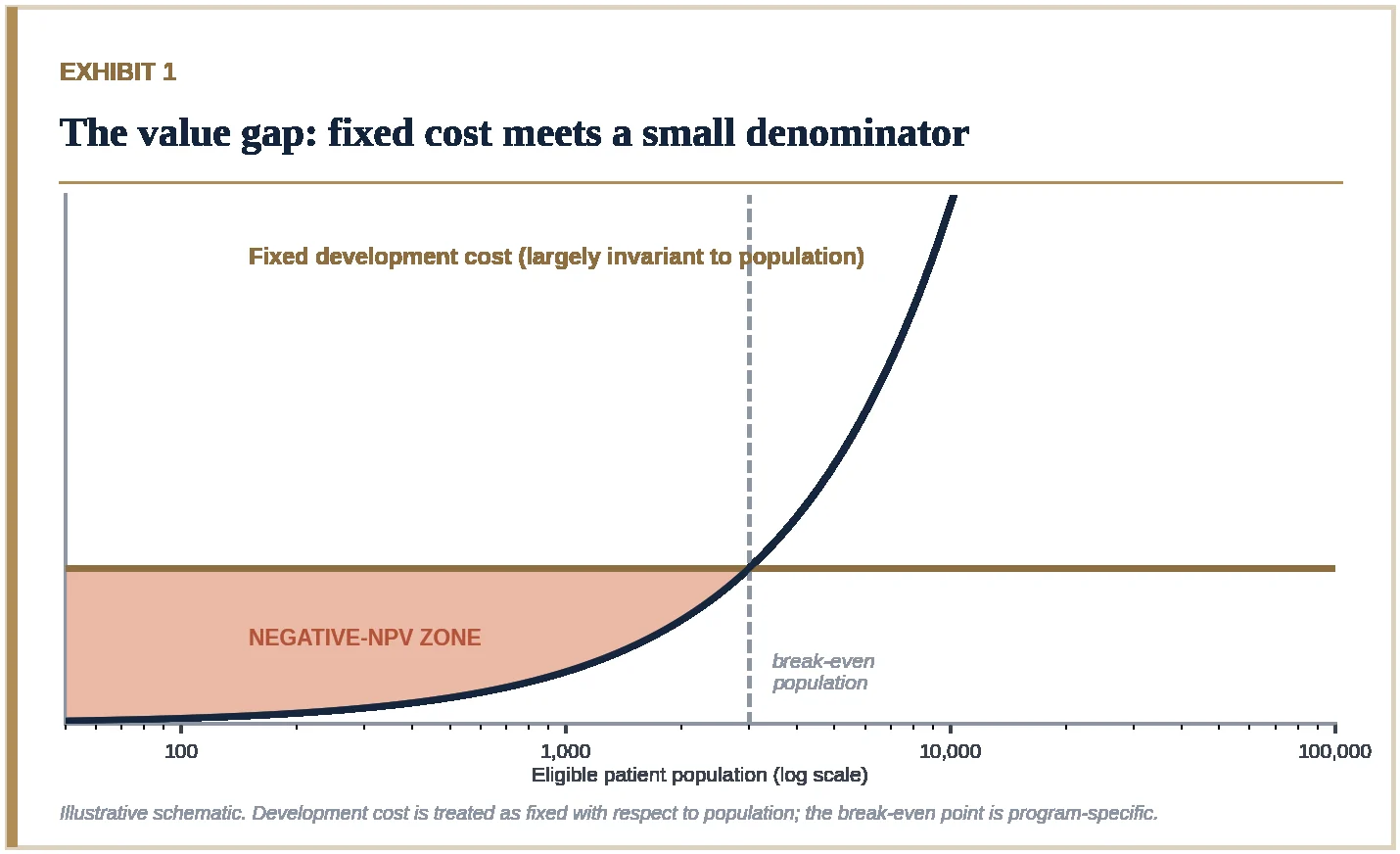
Exhibit 1. The value gap. Below a program-specific break-even population, no tolerable price closes the distance between fixed cost and patient-scaled revenue. Source: The Modeste Duncan Group analysis.
A.1 The one-time price is a symptom, not the cause
Approved one-time cell and gene therapies carry US list prices between roughly \$2.1 million and \$4.25 million (Exhibit 2).6 Those figures are not evidence of excess. They are a fixed cost divided by a small denominator, collected in a single administration. The difficulty is not the size of the number. It is that a one-time charge meets a payment system built for chronic, installment-based therapy, and a payer whose enrollee may have changed plans long before the benefit is fully delivered.
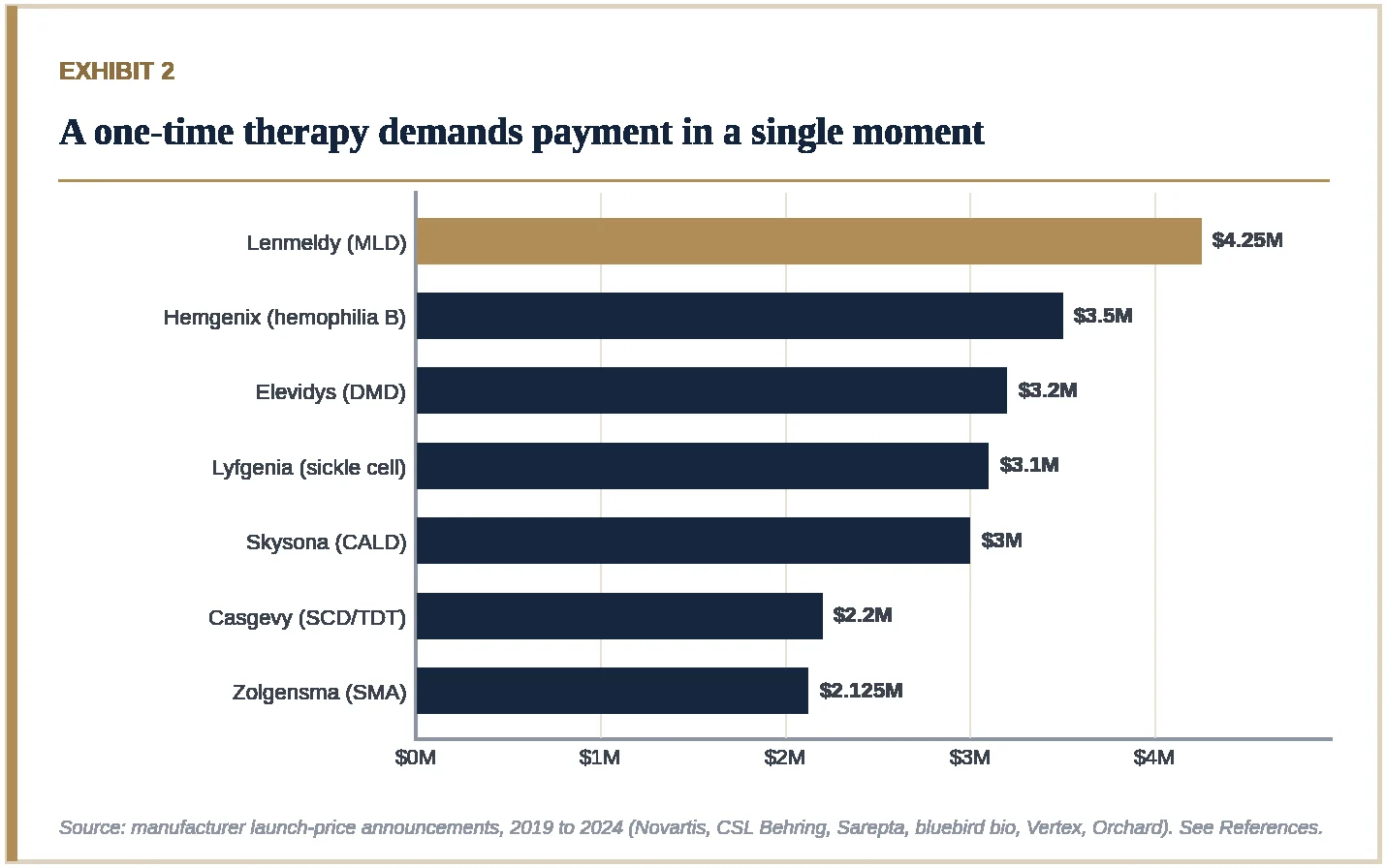
Exhibit 2. US launch list prices of approved one-time cell and gene therapies. Source: manufacturer launch-price announcements, 2019 to 2024; see References.
A.2 The standard escape routes are closed
The usual incentives do not close the gap. Each fails for a reason that cannot be patched:
• Orphan exclusivity2 protects a developer from competitors in a market no competitor wants to enter. It is worth little when the binding constraint is demand, not competition.
• The priority review voucher behaves like a lottery ticket, not a revenue line. Its price is set in a thin secondary market, it is not guaranteed, and the program that generates most vouchers lapsed once before being reauthorized only through September 2029.9 A company cannot underwrite an asset with that profile.
• Venture return targets cannot accommodate a program whose realistic ceiling is a few hundred patients. The fund's cost of capital and the program's addressable market do not reconcile.
A.3 The pattern is already visible in the market
The clearest evidence that this is a structural problem, not a scientific one, is the set of therapies that were approved, shown to work, and then withdrawn for lack of a workable payment model. Glybera, the first gene therapy approved in the West, carried a price above \$1 million, was reimbursed for a single commercial patient, and was withdrawn in 2017.4 bluebird bio withdrew Zynteglo and Skysona from Europe in 2021 after it could not reach reimbursement terms.5 The pattern has since continued and intensified. bluebird bio withdrew Skysona from the United States in early 2025 after recording no commercial sales in the first quarter, and the company itself was taken private in June 2025, having once carried a market capitalization above \$10 billion. Sarepta's Elevidys, cited below at its 2023 launch price, received a boxed warning and a narrowed label in 2025 following fatal cases of acute liver failure. In every one of these cases the science held and the economics, the safety economics included, did not (Exhibit 3).
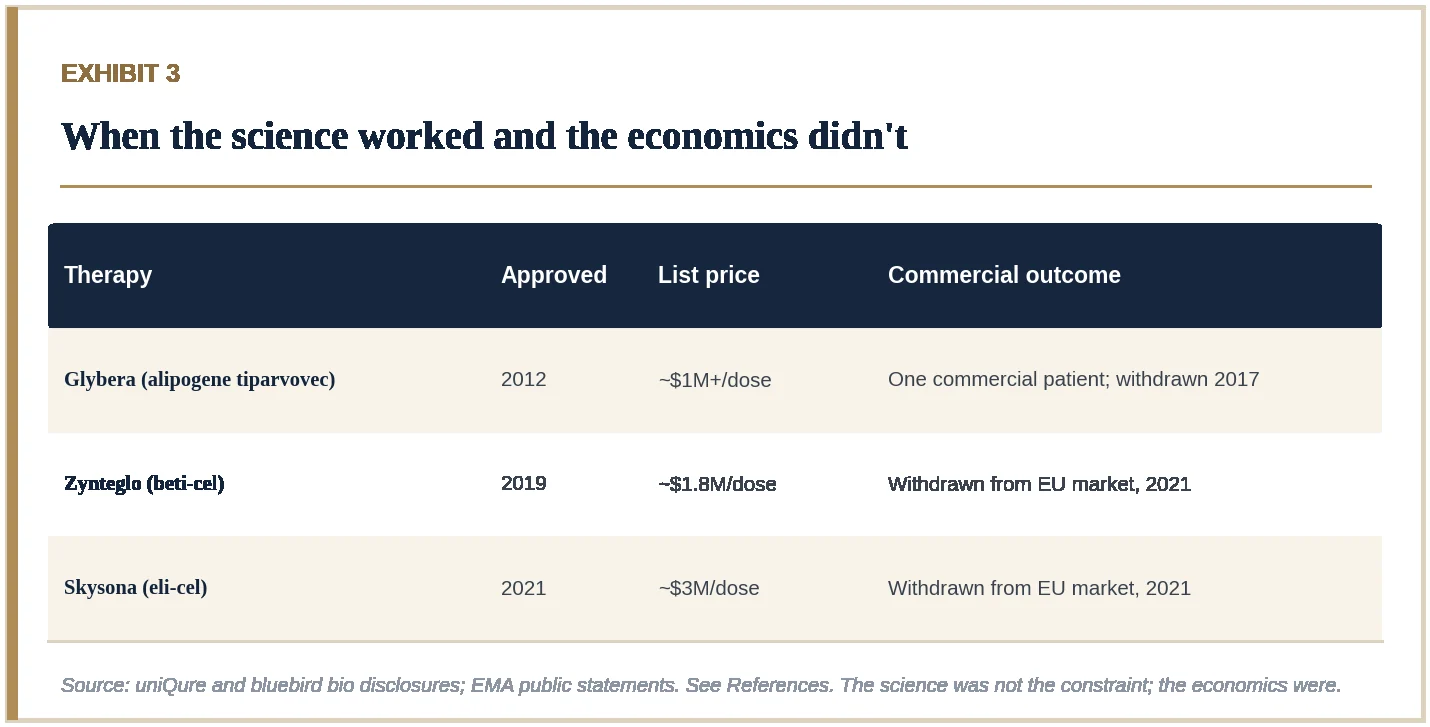
Exhibit 3. When the science worked and the economics did not. Source: uniQure and bluebird bio disclosures; EMA public statements; see References.
Part B · The Architecture
Six Pillars
The six elements below are layers, not options. The structure fails if any one is missing, which is the usual failure mode: a strong platform with no payment model, or a clever financing design on a cost base that never came down (Exhibit 4). The layers rest on governance, because a structure that blends charitable, public, and private capital draws scrutiny in proportion to how much it blends.
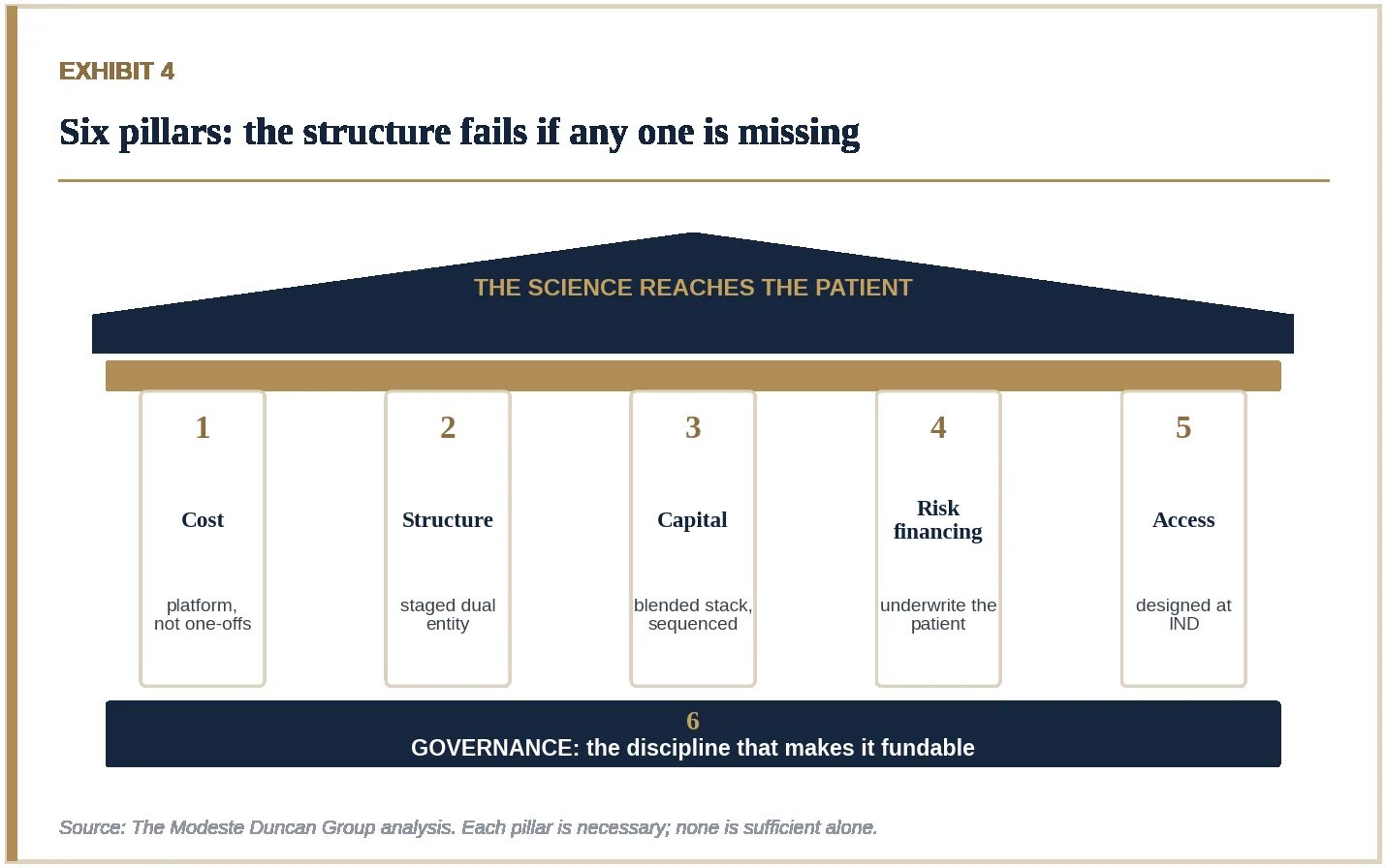
Exhibit 4. The six-pillar architecture. Source: The Modeste Duncan Group analysis.
B.1 Cost: build a platform, not a series of one-offs
The cost of an ultra-rare program is not fixed. It depends on how much of each program is bespoke. A shared platform base spans delivery, process, analytics and release strategy. Add a cluster or umbrella IND, shared toxicology, and a facility built for many small batches rather than a few large ones. Together these lower the marginal cost of the next program well below the cost of the first. In favorable cases the reduction approaches an order of magnitude, though the achievable figure is program-specific. FDA's Platform Technology Designation under §506K is designed to support this kind of data reuse across products.10 This is the pillar that makes the ones above it affordable.
B.2 Structure: the staged dual entity
A charitable foundation carries the earliest phase, where risk is highest and value is hardest to capture: discovery, natural history, registry, and early evidence. A public benefit corporation carries manufacturing, scale, and commercialization. Two mechanics make this more than an org chart. First, the core intellectual property is retained and licensed, not assigned. The design layer stays with its originator and is licensed into the operating entity rather than transferred outright through a work-for-hire assignment, so the mission's central assets cannot simply leave in an acquisition. Second, reversionary covenants return rights to the mission if commercial stewardship fails or is sold. The mission lock has to be contractual rather than aspirational, because only a contractual lock survives a change of control.
B.3 Capital: a blended stack, sequenced by risk
The stack blends philanthropy and disease foundations, public and sovereign capital, venture and strategic equity, and credit or royalty monetization. The discipline is to price each layer to the risk it actually bears, rather than blending everything into one cost of capital. First-loss and catalytic capital, placed where risk is highest, are what make the cheaper layers above them possible (Exhibit 5).
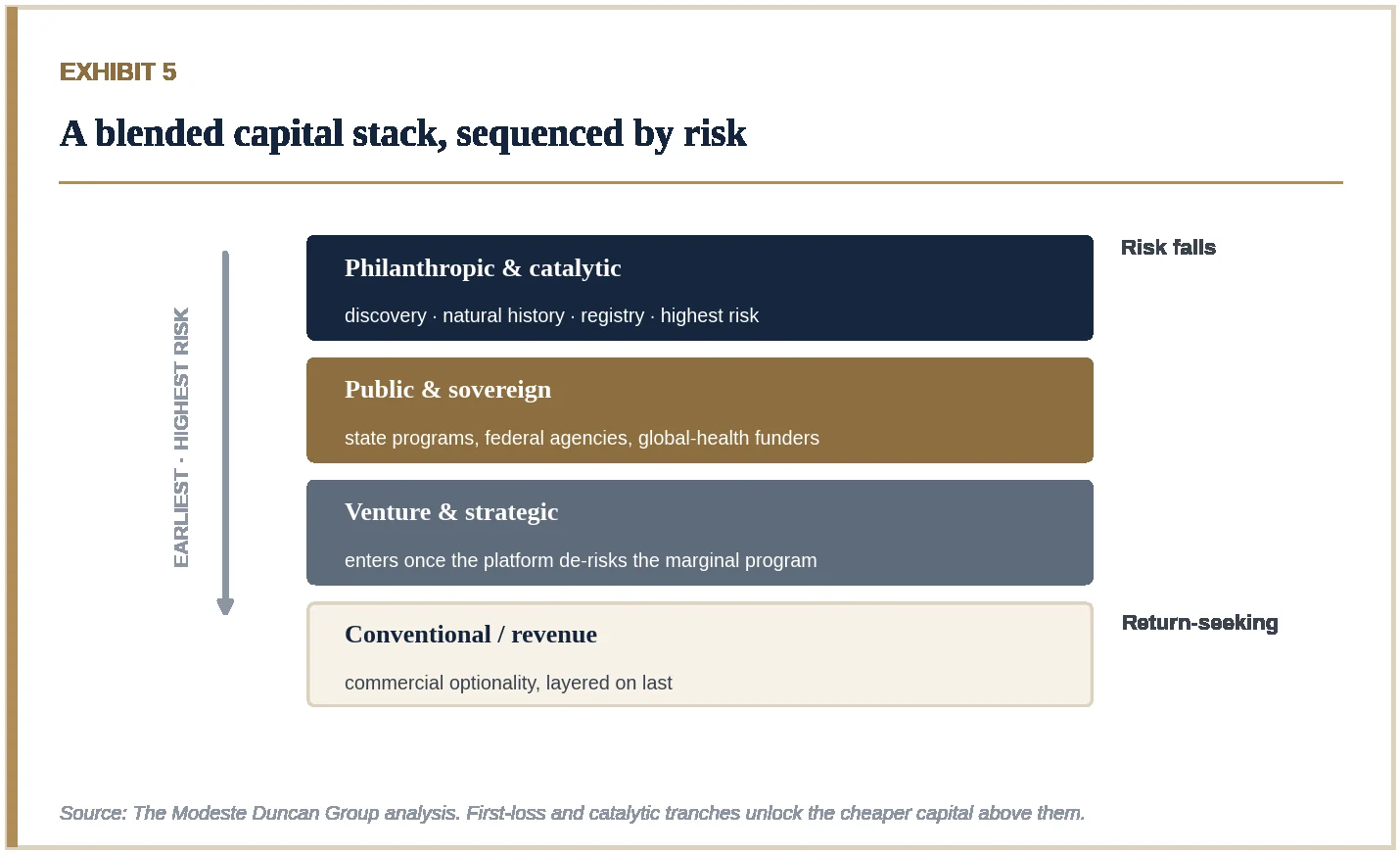
Exhibit 5. A blended capital stack, sequenced by risk. Source: The Modeste Duncan Group analysis.
B.4 Risk financing: underwrite the patient, not the product
This is the layer most often missing, and it does the most work. It combines per-patient underwriting, a first-loss tranche with reinsurance above it, outcomes-linked reimbursement that tracks durability as it is demonstrated, and a clear allocation of loss among manufacturer, payer, and risk carrier. Together these convert an unaffordable single price into a bounded, insurable stream. The CMS Cell and Gene Therapy Access Model, which negotiates outcomes-based agreements for the sickle cell therapies on behalf of states, is an early working example rather than a settled template.7 It is recent and limited to two products, but it shows the mechanism is viable.
B.5 Access: designed at IND, not at launch
Access design includes coding and site-of-care strategy, outcomes-based agreements with pre-specified and measurable durability endpoints, and the registry and long-term follow-up needed to make those contracts operable. A payment term is an evidence claim. You cannot contract on an outcome you cannot measure. Global access adds a separate design problem, tiered and sovereign, and it also begins at IND.
B.6 Governance: the discipline that makes it fundable
A blended structure draws scrutiny precisely because it mixes charitable, public, and private capital, and the sharpest scrutiny falls on any transaction between the foundation and a party close to it. The governing discipline is the related-party regime that applies to tax-exempt entities. Every transaction between the foundation and an insider has to be approved by disinterested directors. That approval has to be supported by fair-market-value comparables, and documented at the time rather than reconstructed later, so that it clears the intermediate-sanctions standard under Internal Revenue Code §4958 and the prohibition on private inurement.13 In practice this means independent directors who can approve or refuse a related-party arrangement, a founder who recuses on any vote in which they hold an interest, and stage gates with real stop criteria. Governance of this kind is not a tax on the model. It is the single thing that turns a structure a sophisticated funder would otherwise distrust into one they can underwrite.
**From practice. Most of the effort in building a structure like this goes into governance and intellectual property rather than into the financing. That is the part clients underestimate, and it is the part that decides whether a blended structure can be funded at all.**
Part C · Selection & Proof
The Selection Rule
The architecture makes some unviable programs buildable. It does not make all of them buildable, and knowing which is which is the first decision, not the last.
*Three conditions have to hold together. The mechanism runs on a platform already owned, so the science is a variation rather than a new build. The marginal cost of this program approaches the marginal cost of the platform, so the economics improve with each addition. And a payment model exists that a named party will underwrite. Two of the three is a program that consumes a foundation's capital and reaches nobody.*
C.1 What this is not
• It is not charity. Each layer is meant to be funded by capital that expects a return matched to the risk it carries.
• It is not price maximization. The model works by lowering cost and spreading risk, not by extracting a higher number from a payer who cannot pay it.
• It is not a subsidy. Public and philanthropic capital is used where it is most efficient, at the point of highest risk and lowest appropriability, not as a permanent operating crutch.
C.2 Mission-first capital, proven
The common objection to mission-first capital is that it is soft money that never returns. The record is more encouraging. The Cystic Fibrosis Foundation used venture-philanthropy investments, reported at roughly \$150 million over many years, to help fund the first medicine that treats the underlying cause of the disease. In 2014 it sold the resulting royalty rights to Royalty Pharma for \$3.3 billion (Exhibit 6).8 Cystic fibrosis is not an ultra-rare disease, and its patient base is larger than the programs discussed here, so the numbers do not transfer directly. The principle does. Catalytic capital placed at the point of highest risk can be the tranche that makes everything above it investable.
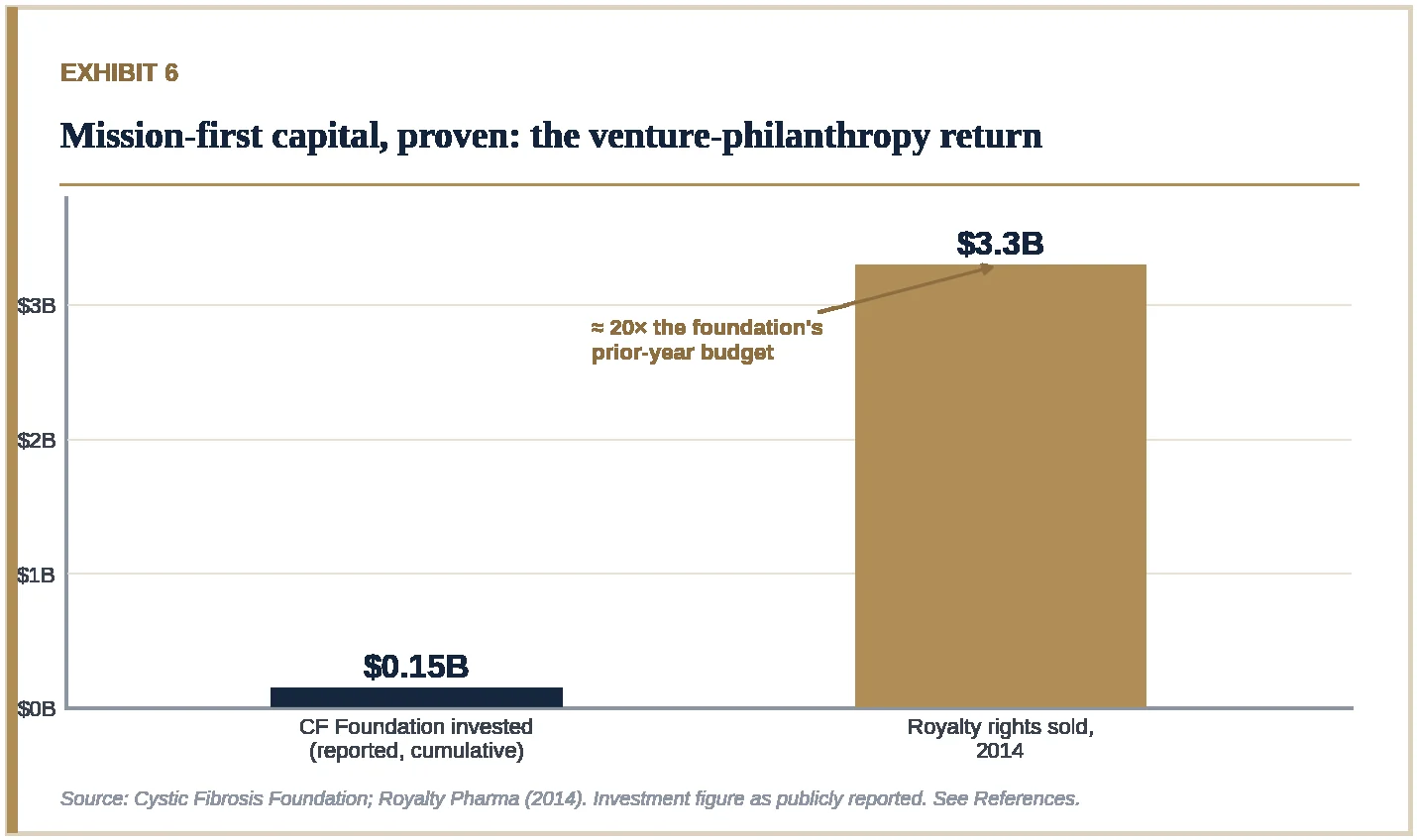
Exhibit 6. Mission-first capital, proven. Source: Cystic Fibrosis Foundation; Royalty Pharma (2014); investment figure as publicly reported; see References.
2Synthesis: An Integrated Operating Model
Woven together, the layers give a thesis that holds up to a skeptical scientific, regulatory, and financial reviewer:
• The platform is the cost engine. A shared platform base and amortizable chemistry, manufacturing, and controls (CMC) lower the marginal program cost, while per-locus safety data is generated program by program.
• The dual entity holds mission and commerce together.
Foundation upstream, public benefit corporation downstream, reversionary covenants binding the two.
• The capital stack is sequenced, not blended. Catalytic first-loss capital unlocks public, venture, and credit layers priced to their real risk.
• Risk financing makes payment underwritable. Per-patient underwriting and outcomes-linked reimbursement turn a single price into an insurable stream.
• Access and governance are built at IND. Certified centers, a registry, outcomes contracts, and disciplined related-party governance make the structure fundable.
3Conclusion and Verification Note
The diseases in this class are not waiting for better science. They are waiting for a structure that lets the science reach patients. That structure can be designed, and the design is the work. Whether a program is uneconomic is a question about structure, and structure is a choice.
Verification note. The statutory and program facts cited here were confirmed against primary FDA, CMS and Congressional sources as of June 2026.
- They include the Orphan Drug Act, §506K Platform Technology Designation, the Rare Pediatric Disease PRV program and its 2029 reauthorization, and the CMS CGT Access Model. Development-cost estimates are drawn from the published literature and remain contested. Market figures, including therapy list prices, the Cystic Fibrosis Foundation royalty transaction, and therapy withdrawals, reflect company, foundation, and regulator disclosures. These figures should be re-confirmed against primary sources before external use, and capital-structure conclusions confirmed with qualified counsel and financial advisors.
Appendices
Appendix A · The Capital Stack in Detail
Each tranche is priced to the risk it bears and sequenced so that the highest-risk, least-appropriable capital enters first.
| Tranche | Role in the stack | Risk borne | Representative instruments |
|---|---|---|---|
| Philanthropic / catalytic | Discovery, natural history, registry, early evidence | Highest; least appropriable | Foundation grants; program-related investments; first-loss guarantees |
| Public / sovereign | De-risking, infrastructure, global access | High; policy-contingent | Federal agencies; state programs; global-health funders |
| Venture / strategic | Scale-up once the platform de-risks | Moderate; equity-priced | Preferred equity; strategic partnerships; milestones |
| Credit / royalty | Monetizing proven cash flows | Lowest; cash-flow-backed | Royalty sales; debt; outcomes-linked notes |
Appendix B · Financing Precedents
Each precedent supports specific pillars of the model. None is a complete template. Together they show the model is assembled from working parts.
| Precedent | What it shows | Limitation |
|---|---|---|
| CF Foundation / Vertex | Venture philanthropy can seed a first-in-disease drug and return capital at scale | Larger, more prevalent patient base |
| CMS CGT Access Model | A one-time cure can be paid via centrally negotiated, outcomes-based agreements | Recent; two products to date |
| Glybera (cautionary) | A one-off product-plus-price structure fails at ultra-rare scale | Withdrawn after one commercial patient |
| Rare pediatric PRV | Policy incentives exist but cannot be underwritten | Lapsed once; value volatile |
References
Statutory and program citations reflect settled or currently effective U.S. law and policy as of June 2026; draft guidances are identified as such. Market and transaction figures reflect company, foundation, and regulator disclosures and should be re-confirmed against primary sources before external use. Citations were verified to September 2026; where a source postdates the paper, the later status is given.
1. DiMasi JA, Grabowski HG, Hansen RW. “Innovation in the pharmaceutical industry: New estimates of R&D costs.” Journal of Health Economics 2016 May;47:20–33. doi:10.1016/j.jhealeco.2016.01.012. PMID 26928437 (pre-tax capitalized cost per approval \$2,558M in 2013 dollars). Note that this estimate is debated; lower published estimates exist. The paper's argument depends only on cost being large and largely fixed relative to eligible population.
2. Orphan Drug Act of 1983, Pub. L. No. 97-414 (seven-year exclusivity and development incentives for rare-disease products).
3. Approximately 7,000 recognized rare diseases, a minority of which have an FDA-approved treatment. NIH Genetic and Rare Diseases (GARD) program; American Society of Human Genetics rare-disease fact sheet.
4. Glybera (alipogene tiparvovec), uniQure, the first gene therapy approved in the West (EU, 2012; lipoprotein lipase deficiency); list price above \$1M. Primary sources: uniQure, “uniQure Announces It Will Not Seek Marketing Authorization Renewal for Glybera in Europe” (SEC Form 8-K, Exhibit 99.1, and press release, April 20, 2017; authorization expired October 25, 2017); European Medicines Agency, public statement on expiry of the Glybera marketing authorisation (2017). Reimbursed for a single commercial patient, as reported at withdrawal.
5. bluebird bio, withdrawal of Zynteglo and Skysona from the European market (2021) after reimbursement terms could not be agreed (EU list price ≈ €1.575M / \$1.8M). Primary source: bluebird bio, Inc., SEC filings (Forms 8-K and 10-K, 2021 to 2022).
6. US launch list prices at approval, from manufacturer announcements. Note that list prices move: one of these carried a materially higher wholesale acquisition cost by 2025. Zolgensma \$2.125M (AveXis / Novartis, May 2019); Elevidys \$3.2M (Sarepta, June 2023); Casgevy \$2.2M (Vertex / CRISPR Therapeutics, Dec. 2023); Lyfgenia \$3.1M and Skysona \$3.0M (bluebird bio, Dec. 2023 and Sept. 2022); Hemgenix \$3.5M (CSL Behring, Nov. 2022); Lenmeldy \$4.25M (Orchard Therapeutics, March 2024).
7. CMS Innovation Center, Cell and Gene Therapy (CGT) Access Model; HHS press release, “CMS Expands Access to Lifesaving Gene Therapies Through Innovative State Agreements” (2025). The model is recent and, to date, limited to the sickle cell therapies.
8. Royalty Pharma, “Royalty Pharma Announces \$3.3 Billion Royalty Transaction with Cystic Fibrosis Foundation Therapeutics” (press release, November 19, 2014); confirmed against Cystic Fibrosis Foundation press release of the same date and Royalty Pharma SEC filings. Cystic Fibrosis Foundation, “Our Venture Philanthropy Model” (cumulative investment in Vertex of roughly \$150M). Cystic fibrosis is not ultra-rare, so the figures are illustrative rather than directly transferable.
9. Rare Pediatric Disease Priority Review Voucher program: created by the FDA Safety and Innovation Act (2012); lapsed for new designations after Sept. 30, 2024; reauthorized through Sept. 30, 2029 by the Consolidated Appropriations Act, 2026. See also U.S. Government Accountability Office, Drug Development: FDA’s Priority Review Voucher Programs (GAO-20-251, January 2020).
10. FD&C Act §506K, Platform Technology Designation, added by the PREVENT Pandemics Act (2022); FDA, “Platform Technology Designation Program for Drug Development; Draft Guidance for Industry” (May 2024). Draft guidance, subject to change.
11. On precision financing for one-time therapies, see MIT NEWDIGS FoCUS, “Paying for Cures” (milestone contracts, performance-based annuities, reinsurance pools); ICER and NEWDIGS, “Managing the Challenges of Paying for Gene Therapy” (2024); and the Duke-Margolis Health Policy Center cell and gene therapy work. This paper builds on that payment literature and addresses the governance and IP architecture it does not.
12. American Society of Gene & Cell Therapy, “Overcoming Barriers to Commercially Pre-Viable Gene and Cell Therapies for Rare and Ultra-Rare Diseases” (policy statement, 2025).
13. Internal Revenue Code §4958 (excess-benefit transactions; intermediate sanctions) and the prohibition on private inurement under §501(c)(3); rebuttable presumption of reasonableness via independent approval, fair-market-value comparables, and contemporaneous documentation.
Abbreviations and Key Terms
Common abbreviations used in this paper. Key terms are also defined at first use in the text.
| CALD | Cerebral adrenoleukodystrophy | MLD | Metachromatic leukodystrophy |
|---|---|---|---|
| CGT | Cell and gene therapy | NPV | Net present value |
| CMC | Chemistry, manufacturing, and controls | PBC | Public benefit corporation |
| CMS | Centers for Medicare & Medicaid Services | PRV | Priority review voucher |
| DMD | Duchenne muscular dystrophy | R&D | Research and development |
| FDA | Food and Drug Administration | SCD | Sickle cell disease |
| GMP | Good manufacturing practice | SMA | Spinal muscular atrophy |
| IND | Investigational New Drug application | TDT | Transfusion-dependent beta-thalassemia |
| IP | Intellectual property | §506K | Platform Technology Designation |
| LNP | Lipid nanoparticle | IND (cluster) | Shared filing across related programs |
