
Executive summary
Do not cut before the assumption audit. A company that reduces before establishing what actually changed will cut the wrong things by exactly the amount of the misunderstanding, and it will do so with confidence, because the arithmetic will be correct.
Scenario work is standard. It is also, almost always, built by varying inputs around a single plan. A decisive readout does something different: it does not widen a range, it produces a different company on each side of the result. A clinical-stage company with a decisive readout ahead of it does not have one future. It has a branch point, and the company on the far side of that branch has a different cost base, a different headcount and in some cases a different reason to exist.
I have built this planning structure for a clinical-stage company holding two lead programs into a readout, with a runway that ended before the programs could pay for themselves. The finding that reframed the work was that nothing had been overspent. A single planning assumption, that both programs would be partnered after the mid-stage readout and somebody else would fund the pivotal work, had been carrying the entire long-term plan. When that assumption came out and pivotal costs were rebuilt from the bottom up with the function leads, the runway moved by more than a year.
This paper sets out how to find that kind of assumption, and how to structure reductions around a data event rather than a calendar date. It gives the rule for deciding what to cut before the readout and what to stage behind it. It also locates the floor past which further cutting destroys the thing paying for the cuts.
Examples are drawn from prior engagements and are described by organizational scale only. No organization, program, partner or individual is identified, and no forecasts, headcount figures, dates or financial values appear.
1Find out where the runway actually went
Before designing any reduction, answer one question precisely. What changed? There are only four candidates, and organizations reliably investigate the wrong one first.
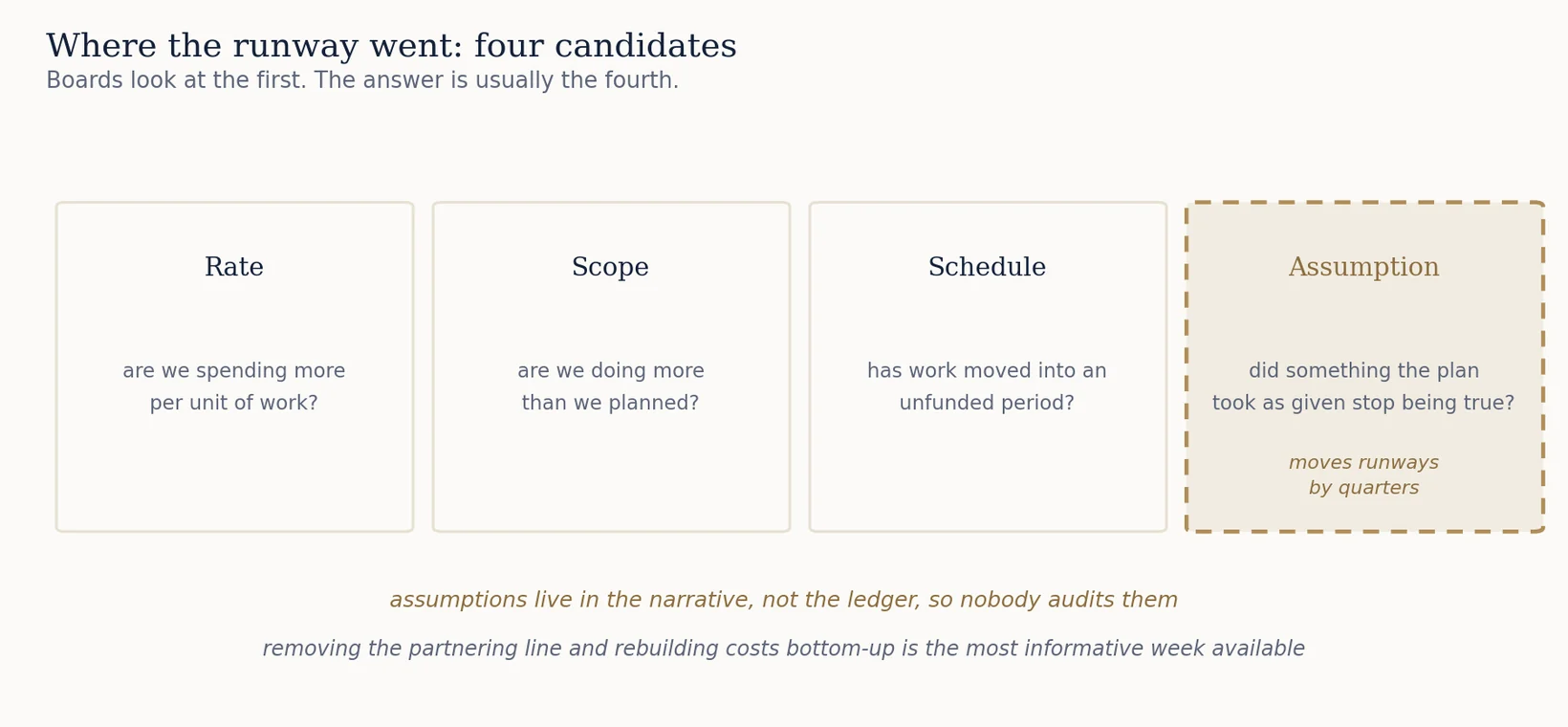
Exhibit 1. Four candidates for a lost runway, and where the answer usually is. Source: The Modeste Duncan Group analysis.
Rate
Are we spending more per unit of work than planned? This is where boards look first and where the answer usually is not. A company burning to plan on every line can still lose a year of runway.
Scope
Are we doing more than we planned to do? Additions accumulate quietly through the year and are worth auditing, though they rarely move a runway by quarters.
Schedule
Has work moved into a period it was not funded for? Real, and usually visible.
Assumption
Did something the plan took as given stop being true? This is the one that moves runways by more than a year, and it is the one nobody audits, because assumptions live in the narrative rather than in the ledger.
The assumption I would look for first in any clinical-stage plan is the one about who pays for the next phase.4 Plans routinely carry a partnering event that funds pivotal work, entered as a line in a model years out, never stress-tested, and load-bearing for everything after it. Removing it and rebuilding the pivotal cost from the bottom up with the people who would actually run the work is the single most informative week a leadership team can spend.3
Two things make this exercise hard, and both are worth naming to whoever asks for it. It surfaces a large negative number, and the people who would present it are the people who wrote the original plan. That combination is why the audit gets deferred, and deferring it does nothing except shorten the time available to respond.
2The runway is a set of branches
Once the true position is known, the temptation is to produce a revised single number. Resist it. A revised single number repeats the original error with better arithmetic.
The readout is a branch point. With two programs reading out, there are four states of the world, and each one implies a different company.5
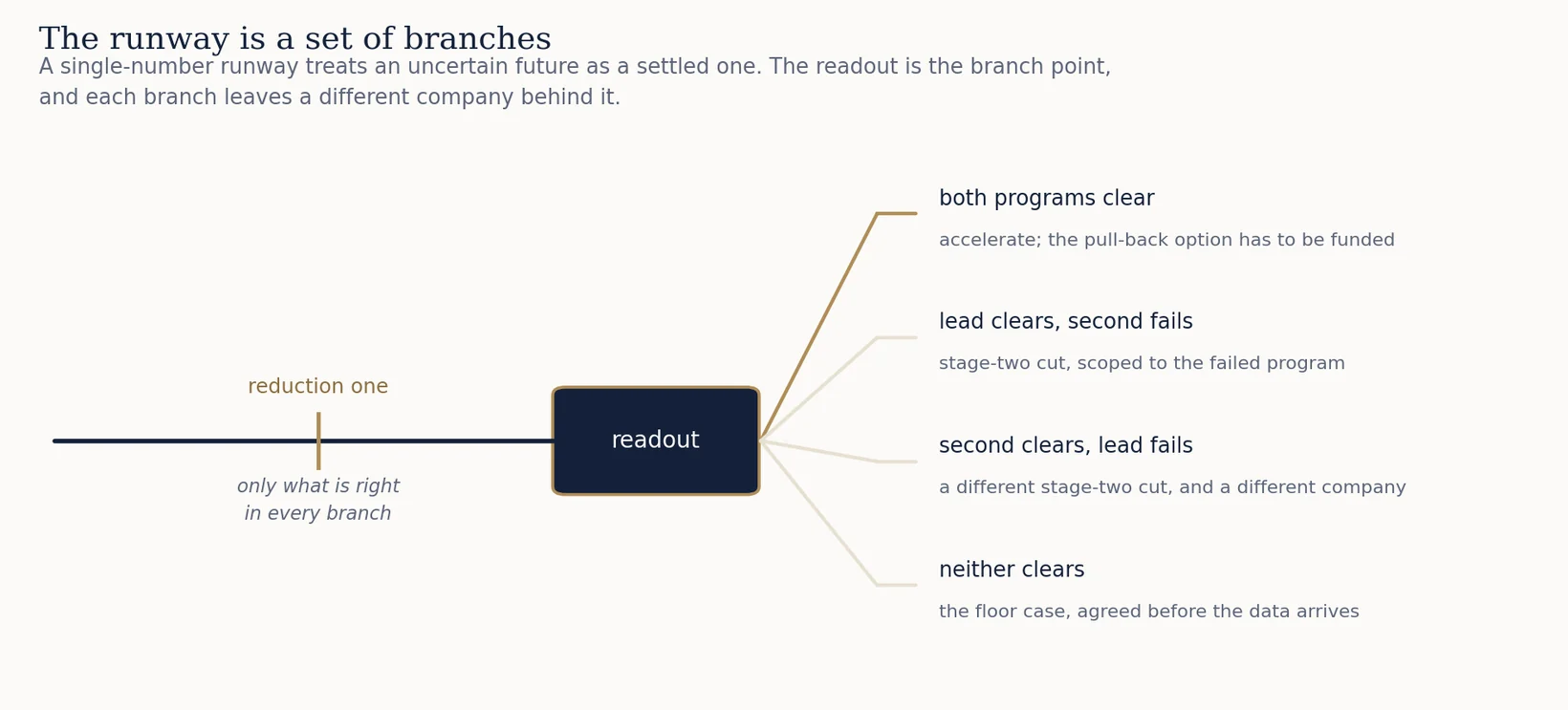
Exhibit 2. The structure, with one reduction taken before the branch point and the rest staged behind it. Source: The Modeste Duncan Group analysis.
Building the plan this way costs more analytical effort and produces something a board can actually use. Each branch carries its own cost base, its own reduction, and its own runway. The board is no longer approving a number. It is approving a set of responses, one of which will turn out to be the real plan.
There is a fifth branch that most plans omit, and omitting it is the more expensive mistake. If the data is good, the company needs to accelerate, and acceleration costs money at precisely the moment the company has least of it. A plan that models only the downside leaves a management team unable to act on success. The option to pull work forward has to be funded, or it is not an option.
3What to cut before the readout, and what to stage behind it
This is the decision the whole exercise turns on, and there is a rule for it.
Ask in which branches each reduction is the right call
If the answer is every branch, take it now. If the answer is some branches, stage it behind the readout. If the answer is one branch, it is not a plan, it is a bet, and it should be named as one before it is approved.
That rule does most of the work. Discretionary spend, deferred capability building, and programs already failing on their own merits are right in every branch, so they go early. Reductions scoped to a specific program are right in one or two branches, so they wait.
The rule has a second half, and it is the part that separates a good plan from a defensible one.
The Reversal Ladder
Sensitivity analysis varies an input and reports what happens to an output. It has nothing to say about how hard a decision is to undo, which is the property that determines what a reduction costs in optionality. The Reversal Ladder orders the levers by that property alone.
Reductions differ enormously on this axis and organizations treat them as though they were interchangeable.
| Lever | Cost to reverse |
|---|---|
| Discretionary and departmental spend | Days. Turn it back on. |
| Consultants and contractors | Weeks, and usually the same people. |
| Deferred capability and platform work | A season, plus the momentum lost. |
| Permanent staff | Two or three quarters, plus a recruiting market that now knows. |
| A terminated program | Frequently never. Material, site relationships and regulatory position all decay. |
Exhibit 3. Source: The Modeste Duncan Group analysis.
Order early reductions from the top of that table downward. Doing so buys the maximum runway per unit of foreclosed optionality, which is the actual objective. A plan that reaches its runway target using only the top three rows has preserved every strategic choice. A plan that reaches the same target by terminating a program has bought identical time and sold the company's future to do it.
4Two ways to size a reduction, and only one survives a board
When headcount reduction becomes necessary, there are two ways to derive the number and the difference between them is not cosmetic.
Top-down, by department
Take one or two positions from each department, scaled by department size. It is fast, it looks equitable, and it can be produced in an afternoon.
It also has no argument behind it. Asked why a given function lost a given number of people, the honest answer is proportionality, which is a principle about fairness rather than about the business. Worse, it removes capability in proportion to current size rather than to future need, so the functions that will carry the next two years lose people at the same rate as the functions that will not.
Bottom-up, from the work
Start from the clinical and regulatory plan under each branch. No new studies this year. This study begins in that year. This filing follows. From that, derive which roles are needed, at what level, and from when. The reduction falls out of the schedule.
This takes weeks rather than an afternoon and it produces something defensible in three separate rooms: with a board, with the functions whose people are affected, and with the individuals themselves. It also produces a materially different answer, because work is not distributed in proportion to headcount.
I would not present a top-down number to a board. It invites the question of what analysis sits behind it, and there is no good answer.
5No single lever gets there
Across the scenario set I built, the conclusion that mattered was that no individual lever produced a sufficient runway. Labor alone did not. Stopping projects alone did not. Delaying pivotal work alone did not. Reducing overhead alone did not.
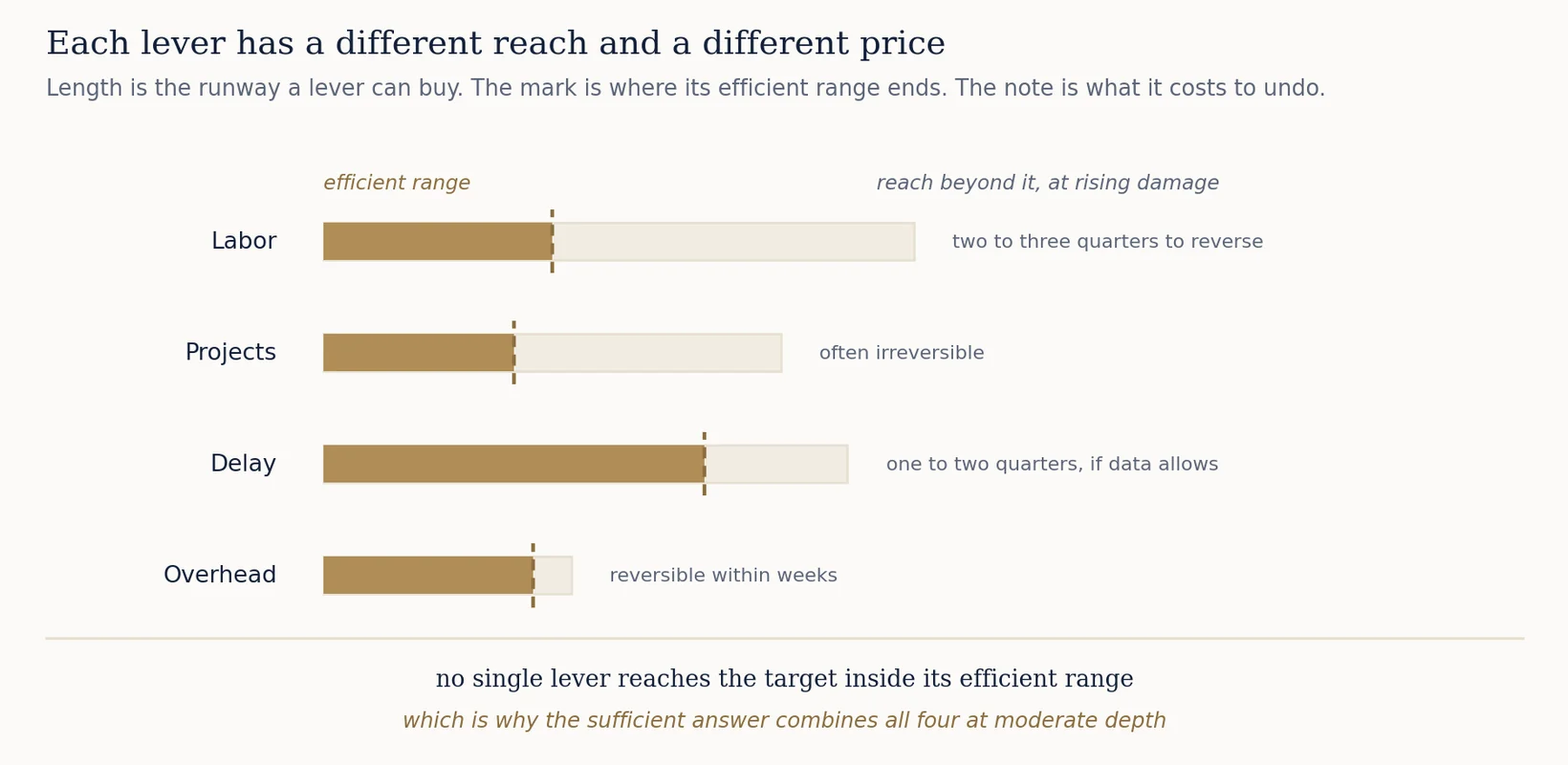
Exhibit 4. Each lever has an efficient range, and past it damage rises. Source: The Modeste Duncan Group analysis.
The sufficient answer combined all of them at moderate depth rather than any one of them at maximum depth, and the difference between those two shapes is the whole argument for modeling the levers separately before combining them.
The reason is structural. Each lever has a depth past which its marginal return falls and its damage rises steeply. Labor reduction past a point removes the capability to run the remaining work. Project termination past a point removes the pipeline the company is valued on. Delay past a point moves work outside the runway entirely, so it saves nothing and costs everything.
The planning implication is that a reduction target should be met by combining levers to the point where each is still in its efficient range, rather than by exhausting the politically easiest one. The politically easiest one is almost always labor, which is also the one with the longest reversal time.
6The floor
There is a depth at which further cutting becomes cash-negative, and most reduction exercises never look for it.
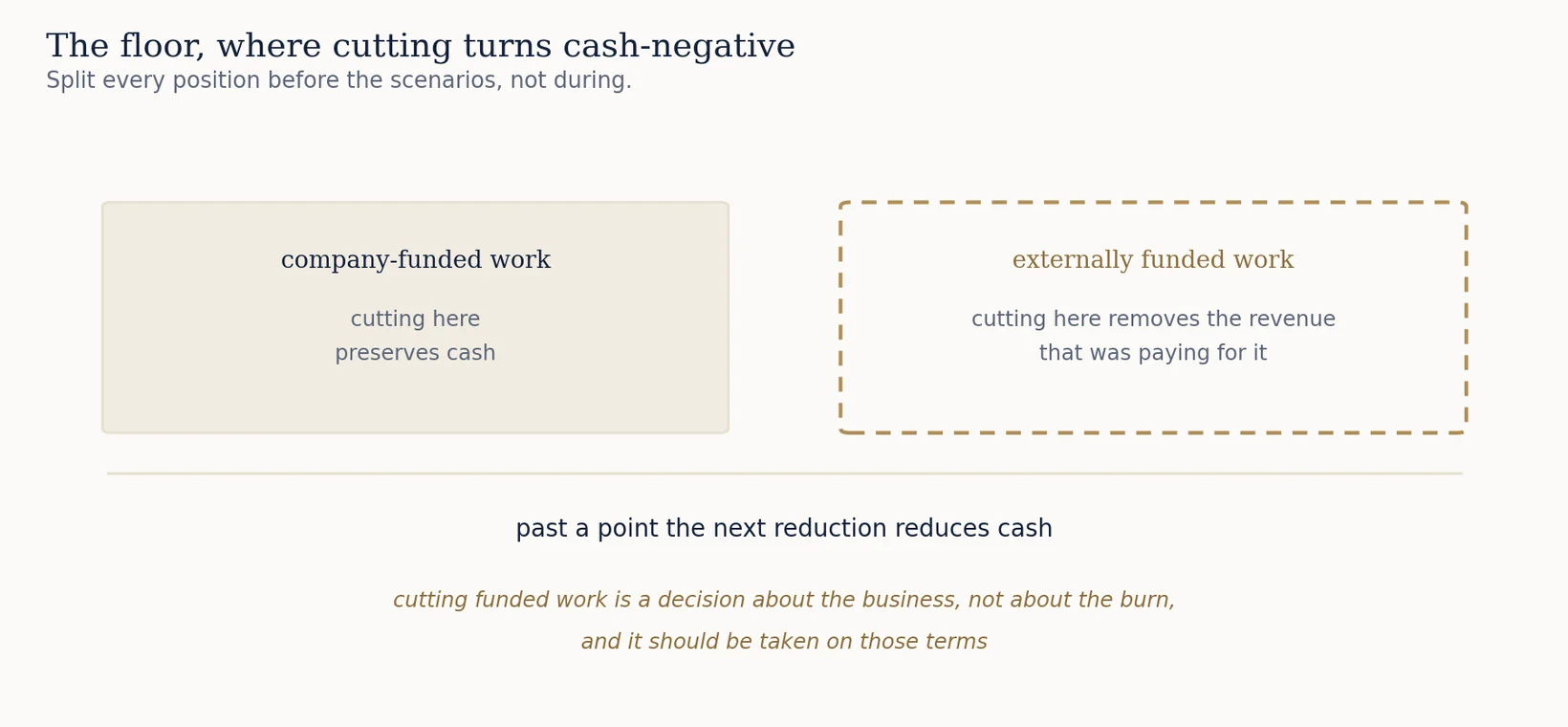
Exhibit 5. The split that locates the floor, drawn before the scenarios. Source: The Modeste Duncan Group analysis.
Externally funded work pays for the people doing it, and usually contributes to overhead as well. Cut into that work and headcount falls, but so does the revenue supporting it, and past a certain point the next reduction reduces cash rather than preserving it. In the bear case I modeled, this had to be flagged explicitly, because the deepest reductions on the table would have impaired the programs that were funding the company.
The instrument is straightforward and I would build it before the scenarios rather than during. Split every position into work funded by a collaboration or grant against work funded by the company. Cutting the second preserves cash. Cutting the first is a decision about the business rather than about the burn, and it should be made on those terms.
That split also improves the conversation with a board, because it distinguishes the part of the cost base the company controls from the part it has already sold.
7Two failure modes that appear reliably
The second reduction never happens
This is the common one and the mechanism is well documented. When a readout is ambiguous, and readouts frequently are, the interpretation chosen under pressure is the one that avoids the cut.12 The people making the call are the people who chose the program, which is exactly the condition under which commitment escalates rather than resolves.
The countermeasure is to write the success criterion before the data arrives, with enough specificity that a disinterested reader could apply it. What result triggers which branch, agreed and minuted, while nobody knows the answer. That is a fifteen-minute conversation before unblinding and an unwinnable argument afterward.
Stage two lands on the people who delivered stage one
The first reduction removes work as well as people, and the people who remain absorb it. If the second reduction is then sized against current headcount, it falls hardest on a group already carrying more than they were. Size stage two against the work remaining in that branch, using the same bottom-up method, rather than against the organization chart.
8When a single-number plan is the right answer
The branch structure earns its cost under specific conditions, and it is worth being clear about when it does not.
- The readout falls beyond the runway. Then it is not a branch point in any actionable sense. The problem is financing rather than planning, and the effort belongs in the raise.
- One program, not several. With a single readout there are two branches and the tree adds little over a simple contingency. Model both and move on.
- The readout is not decisive. A result that refines a dose or narrows a population changes the plan at the margin. Reserve this machinery for results that change what the company is.
- The outcome is already effectively known. Where the probability is genuinely lopsided, branching is theatre, and building it signals a rigor the analysis does not have.
There is also a governance condition. This structure only helps if a board will engage with it. A board that wants one number will receive one number, and the branches will exist in a leadership team's heads where they cannot be acted on. Where that is the situation, the useful move is smaller: present the single plan, and present alongside it the one page describing what changes in each branch and what has already been agreed to do about it.
9What this does to an organization
Two second-order effects are worth planning for, because both arrive whether or not they are anticipated.
Staged reductions extend uncertainty. A single cut is brutal and finite. A cut followed by a known second decision point holds an entire organization in suspension for the intervening period, and the people most able to leave will do so first. That cost is real and it is worth weighing against the capability preserved by staging. Naming the second decision point publicly, with its date and its criterion, converts an indefinite dread into a defined wait, which is materially easier to work through.
And the plan itself becomes an internal signal regardless of how it is labeled. Programs staged for reduction in three of four branches are read by the people working on them as already cancelled, and behavior follows the reading. Where a program genuinely survives in some branches, that has to be said to the team, with the criterion, or the branch will fail for reasons that have nothing to do with the data.
Conclusion
The single-number runway is a comfortable object. It fits on a slide, it supports a decision, and it is wrong in a way that costs a company its optionality at the moment optionality matters most.
The first move is not the reduction. It is the assumption audit, because a company that cuts before understanding what actually changed will cut the wrong things by exactly the amount of the misunderstanding.
From practice. Two lead programs, one decisive readout, and a runway that ended before either could pay for itself. I built the scenario architecture in this paper for that situation. The assumption audit in section 1 is what reframed the work, and it is the step I would run first anywhere.
Appendix A · Abbreviations and Key Terms
| AOP | Annual operating plan | FTE | Full-time equivalent |
|---|---|---|---|
| CDMO | Contract development and manufacturing organization | PoC | Proof of concept |
| CMC | Chemistry, manufacturing and controls | G&A | General and administrative |
Appendix B · References
Statutory and regulatory citations reflect settled United States law unless identified as draft. FDA and ICH documents were confirmed against primary sources as of June 2026. Draft guidances are identified as such and remain subject to change.
1. Staw, B.M. “Knee-deep in the big muddy: a study of escalating commitment to a chosen course of action.” Organizational Behavior and Human Performance, June 1976, 16(1), 27–44. doi:10.1016/0030-5073(76)90005-2.
2. Sleesman, D.J., Conlon, D.E., McNamara, G. and Miles, J.E. “Cleaning up the big muddy: a meta-analytic review of the determinants of escalation of commitment.” Academy of Management Journal, 2012, 55(3), 541–562.
3. Kahneman, D., Lovallo, D. and Sibony, O. “Before You Make That Big Decision.” Harvard Business Review, June 2011, 89(6), 50–60, 137. PMID 21714386.
4. Paul, S.M. et al. “How to improve R&D productivity: the pharmaceutical industry’s grand challenge.” Nature Reviews Drug Discovery, March 2010, 9(3), 203–214. doi:10.1038/nrd3078.
5. Wong, C.H., Siah, K.W. and Lo, A.W. “Estimation of clinical trial success rates and related parameters.” Biostatistics, April 2019, 20(2), 273–286. doi:10.1093/biostatistics/kxx069. Estimates drawn from 406,038 clinical trial entries covering 21,143 compounds, January 2000 to October 2015.
Published June 2026 by The Modeste Duncan Group, which owns this paper and the methods it describes. Clients receive a license to use them;
