
Executive summary
No first-in-human date should be announced before the material calculation has been done. That is the position this paper defends, and it is narrower and more demanding than it sounds.
A fair challenge to it is that competent teams already build IND dates bottom-up from activity durations. Many do. What a bottom-up schedule still assumes is that material will be available when the activity consuming it begins, and that assumption is usually held by a different function from the one that owns the date. The date that holds is derived from the longest dependent chain in the program, and that chain runs through material.
In first-in-human work I have led, that chain has rarely run through the science. It runs through material and through the people who make it. The toxicology study everyone treats as the critical path cannot start until a specific quantity of clinical-representative material exists at a specific concentration, and that quantity is a calculation anyone can do in an afternoon. Very few teams have done it before naming a date.
This paper works that calculation through, sets out the four readiness axes, and shows how to use the agency's early meeting mechanisms to find out where you actually are before announcing where you will be.
Examples are drawn from prior engagements and are described by organizational scale only. No organization, program, partner or individual is identified. Where a calculation is shown, the values are illustrative.
1What an IND date actually promises
An IND date is not one promise. It is four, and a team can be ready for three.
- A defined manufacturing process able to produce clinical material at the required quality, with assays and preliminary release criteria.
- Definitive toxicology conducted with the intended clinical product.
- A protocol, an investigator brochure and a clinical operation able to run the study.
- A submission that survives a thirty-day review.
That review is where optimism meets arithmetic. The thirty-day IND review involves administrative review followed by discipline reviews across chemistry, manufacturing and controls (CMC), pharmacology and toxicology, and clinical, ending in a determination of whether it is safe to proceed or whether a clinical hold is warranted. Three disciplines each hold a veto.4 A program strong in two and thin in the third does not get two thirds of the way to a study.
The date is a property of the weakest of the four, and the weakest is rarely visible from the chief executive's chair, because it lives in material and analytics.
2The Material Gate
A schedule shows when activities are planned to happen. It does not show that the date is a property of a quantity. That is what this section establishes, and I call it the Material Gate: the point before which no amount of scheduling produces a study, because the study cannot start until a specific mass of clinical-representative material exists, released, in someone's hands.
Here is the step I would run before any date is discussed publicly.
A repeat-dose toxicology study in a non-rodent species, supporting an intramuscular product given on a three-week interval, is a conventional design.9 Take a study with a vehicle control group and three active dose levels, sixteen animals per group split evenly by sex, three doses per animal, and a recovery cohort held past the last dose.
The material requirement follows directly:
*dose level × doses per animal × animals per group × overage = material required per group*
Run it with figures chosen purely to show the shape. At a mid dose of 25 micrograms per animal per dose, three doses, sixteen animals, and a 100 percent overage for analytical, retention and contingency, that single group needs 2,400 micrograms. Sum across the active groups and the study has a total requirement, at three separate concentrations, each of which has to be formulated, filled, released and shipped.
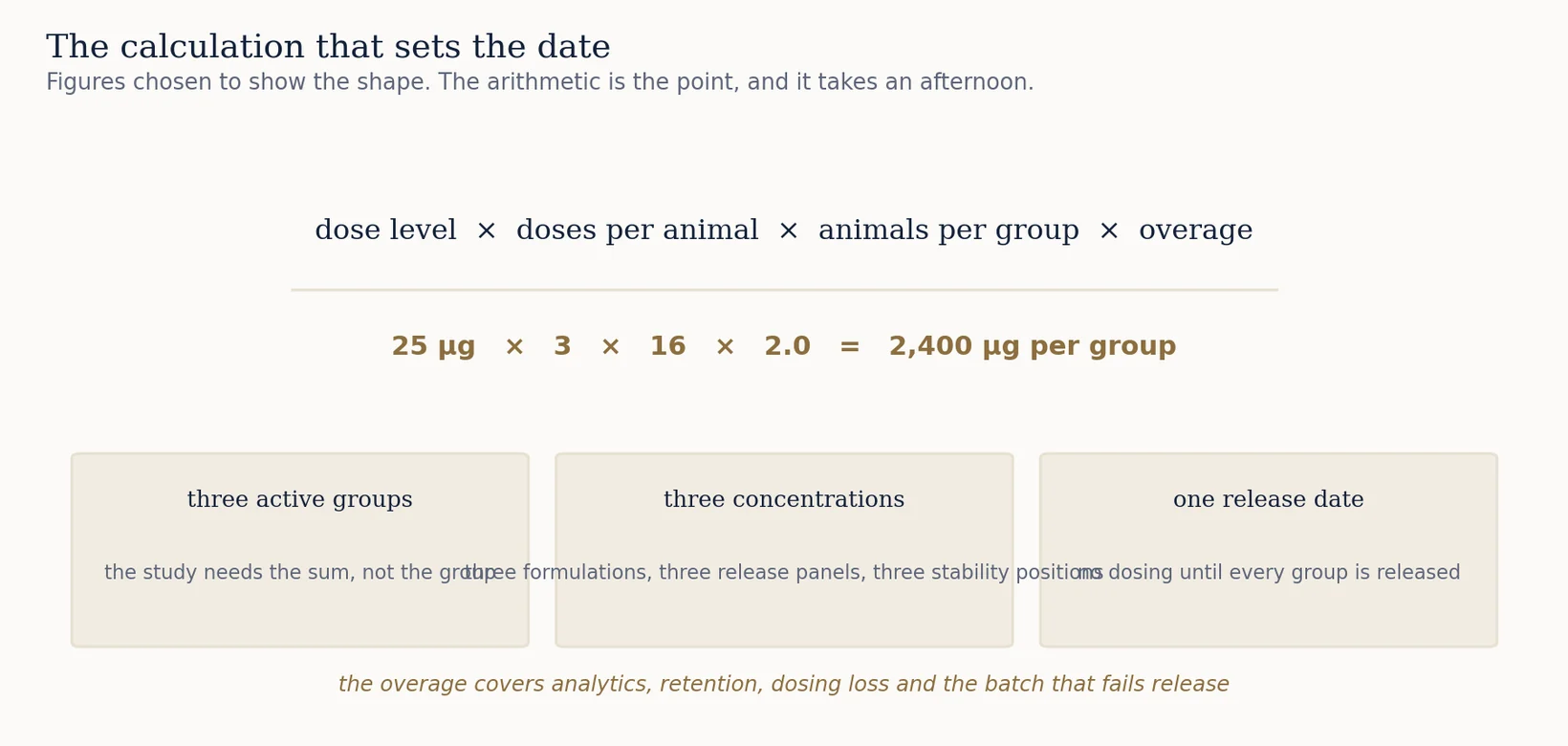
Exhibit 1. The material requirement, and why three dose levels triple the work. Source: The Modeste Duncan Group analysis.
Two things fall out of this, and both determine the date.
The overage is not padding
It covers analytical testing, retention samples, dosing losses and the batch that fails release. Teams that plan without it discover the gap at the point where a repeat batch costs the full campaign duration.
The concentrations multiply the work
Three dose levels means three formulations, three sets of release testing, and three stability positions. A team that has costed one batch has costed a third of the requirement.
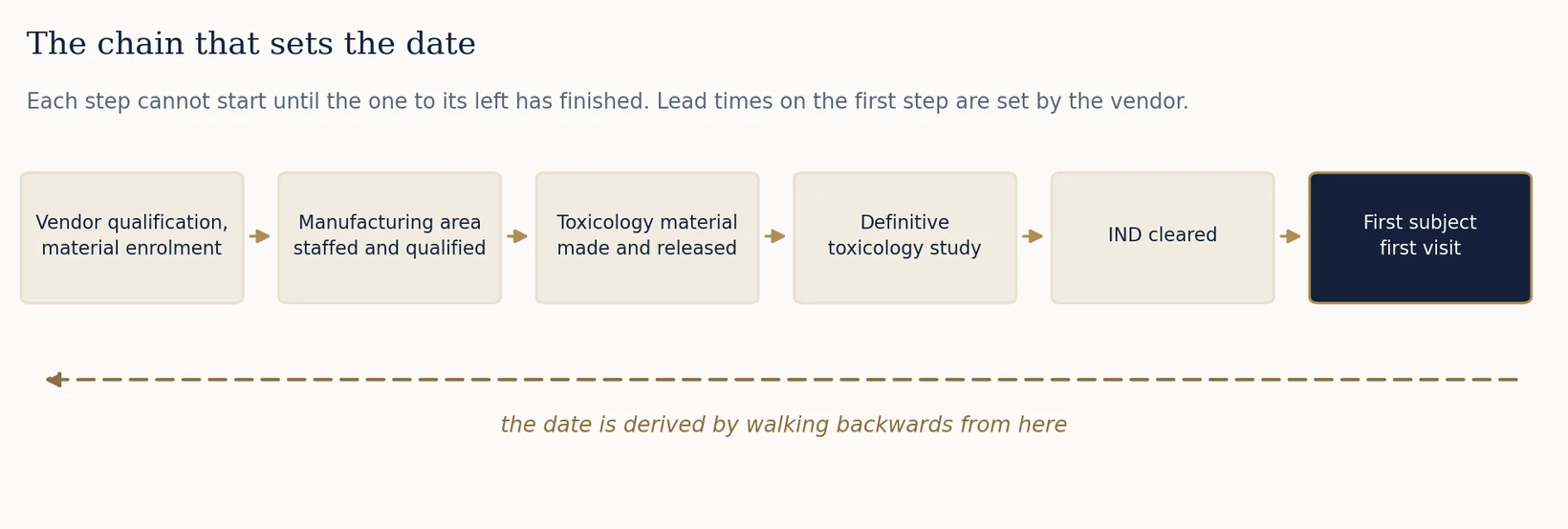
Exhibit 2. Each step is gated by the one before it. Source: The Modeste Duncan Group analysis.
Now walk the chain backwards from first subject first visit. The clinical study needs a cleared IND. The IND needs completed definitive toxicology. The toxicology study needs its full material requirement, released, in hand before Day 1. That material needs a manufacturing campaign in a qualified area. That campaign needs an operations team in place, area maintained, and process constraints understood through water runs and hold-volume work. And it needs raw materials from qualified vendors.
That last item is the one that has caught the most programs I have seen. Vendor qualification and material enrollment run on lead times set by the vendor, not by you, and no amount of internal urgency compresses them. It is the chain that has to be started earliest and is almost always started last, because it feels administrative rather than scientific.
Staffing sits underneath all of it. Bringing permanent staff on runs to a season rather than a sprint, and contingent staff take weeks. A plan that assumes people arrive when the schedule needs them has an unfunded dependency in the middle of the critical path.
3The four readiness questions
Chemistry, manufacturing and controls
Is this the process that will make clinical material, or a version of it? Are assays developed and is there a preliminary release specification? Is there a reference material from a representative batch? Are cell banks tested to the applicable standards?
The distinction that matters is between a process that works in the hands of the person who developed it and a process written down, transferred, and run by someone else to a specification. The first is a scientific result. The second is a manufacturing process.
Toxicology
Is proof of concept complete with the intended clinical product? Is the species justified by the biology? Is the design settled, or does it still depend on a regulatory conversation that has not happened?
The expensive failure is a definitive study run with material that does not represent the clinical product, which converts a completed study into a pilot and adds the full duration of a repeat.
Regulatory
Is the pathway settled, is the classification settled, and has the agency seen the plan?
Clinical operations
Does the protocol match what the process can supply, in quantity and in schedule? Are sites identified and is the population findable? Is there a sponsor-side capability to oversee whatever is outsourced?
4The meeting that tells you where you are
The agency maintains two early mechanisms and choosing correctly between them is itself a readiness signal.
An INTERACT meeting suits a sponsor who has identified the investigational product and conducted preliminary preclinical proof-of-concept work, and who has not yet designed and conducted definitive toxicology studies.1 A pre-IND meeting suits a sponsor further along.2 That sponsor has defined the manufacturing process for clinical studies, developed assays and preliminary lot release criteria, and completed proof of concept alongside possibly some preliminary safety work. Its questions concern IND-enabling chemistry, manufacturing and controls, pharmacology and toxicology, or trial design.
Build the timelines into the plan rather than discovering them.
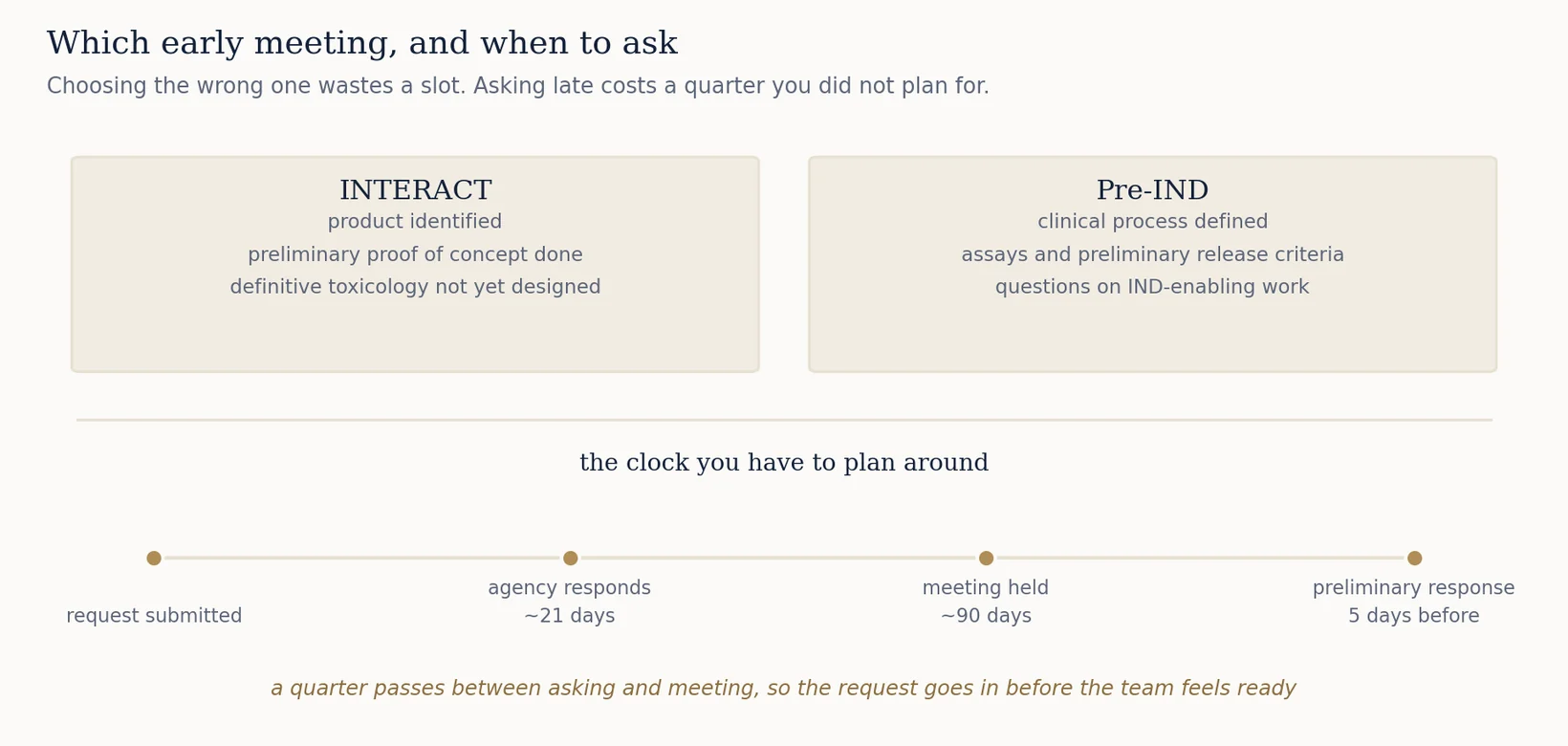
Exhibit 3. Which early meeting, and the clock that runs from the request.\* FDA typically responds to an INTERACT request within twenty-one calendar days and schedules the meeting ninety calendar days from receipt.3 The Office of Therapeutic Products sends its preliminary response no later than five days before the meeting. Source: The Modeste Duncan Group analysis.
A quarter therefore passes between requesting an early meeting and holding it. Request it well before the team feels ready to ask. And note that the preliminary response arrives close enough to the meeting that a team without an agreed process for absorbing it will spend the meeting reacting.
One practice I would carry into any program: run the readiness conversation as a short series of structured cross-functional workshops with minutes, covering clinical design and rationale alongside the CMC development approach and manufacturing plan, and record the baseline assumptions explicitly. Held over days rather than months, that surfaces the mismatch between what the protocol assumes and what the process can supply while both can still change. Anything recorded as a baseline assumption becomes a testable item rather than a shared belief.
5Potency, and the item teams underestimate
Potency is required for biological products, and the expectation at IND is a plan rather than a finished biological activity assay. A surrogate can serve the first study given a credible path toward a biological activity assay for later-phase work. That flexibility is real and it is frequently misread as permission to defer.5
Deferral is costly for structural reasons. The potency assay is the instrument that defines whether a batch is acceptable, which places it upstream of release, upstream of the toxicology material, and upstream of comparability when the process changes. Deferring assay development defers the thing every subsequent decision rests on.5
The readiness question is specific: is there a written potency strategy with a named path to a biological activity assay and a timeline tied to the phase that will require it?
6What the current guidance environment changed
The environment for genetic medicines moved substantially through 2026, in a direction that favors sponsors who have organized their evidence.
FDA issued draft guidance supporting cell and gene therapy development including genome editing, focused on how companies may build on what is already known.6 It encourages early engagement through INTERACT and pre-IND consultations to align data-leveraging strategies before IND filing, and operates alongside a companion draft on off-target editing assessment by next-generation sequencing.7 The Center for Biologics Evaluation and Research also issued final guidance on CMC flexibilities for cell and gene therapy products heading toward a license application, for immediate implementation.8 It formalizes accommodations for limited patient populations, patient-specific manufacturing, short shelf lives and limited batch quantities.
The opportunity is concrete. Prior knowledge can substitute for work a sponsor would otherwise repeat, and the sponsors who capture it arrive at an early meeting with a specific proposal about which data they intend to leverage and why. Arriving without one leaves the flexibility on the table.
7The readiness test
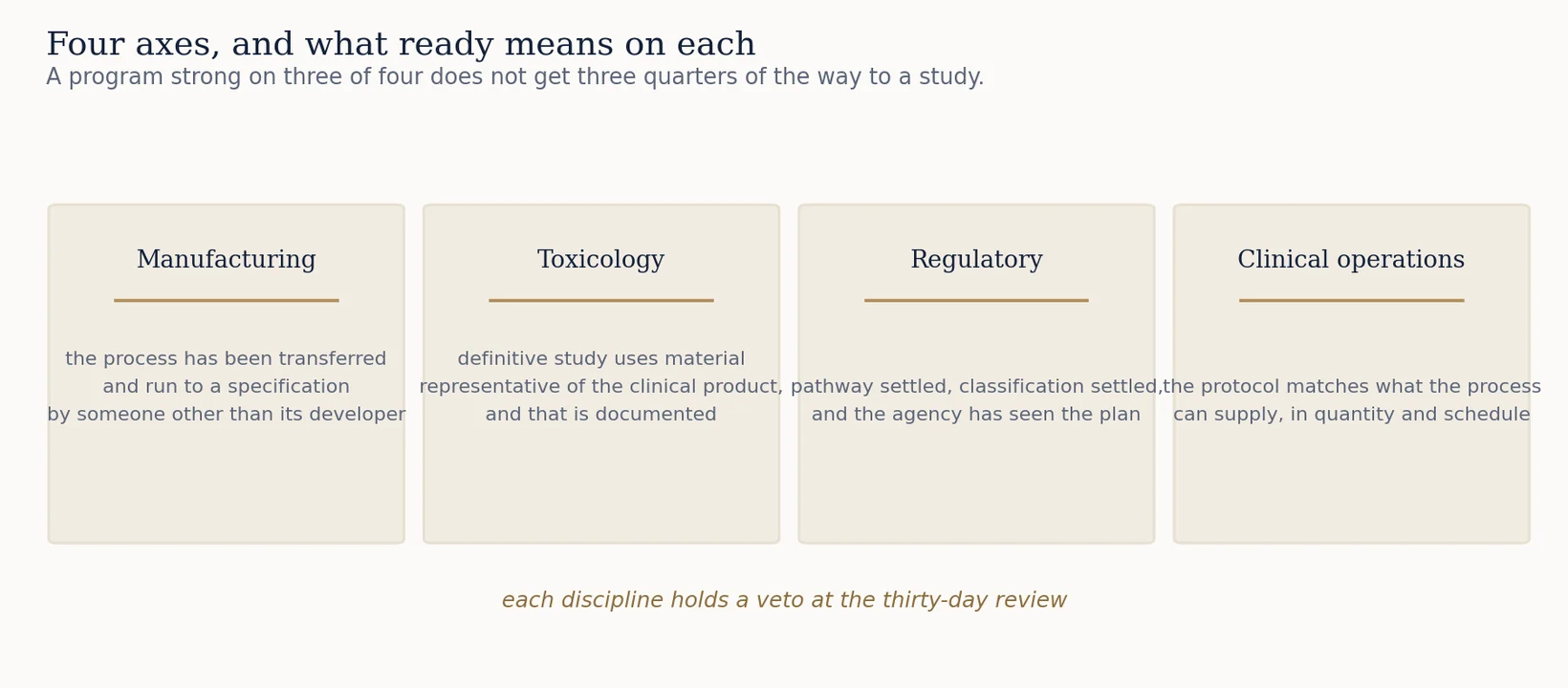
Exhibit 4. The four readiness axes, and what ready means on each. Source: The Modeste Duncan Group analysis.
Before a date is named publicly, each of these should have a written answer with a named owner.
- Has the clinical process been transferred and run to a specification by someone other than its developer?
- Is there a reference material from a representative batch?
- Is there a written potency strategy with a path to a biological activity assay and a phase-linked timeline?
- Has the toxicology material requirement been calculated, including overage and every dose concentration?
- Will definitive toxicology use material representative of the clinical product, and is that documented?
- Are vendor qualification and material enrollment started, with lead times confirmed by the vendors rather than assumed?
- Is the manufacturing area staffed, with onboarding lead times built into the schedule?
- Is the pathway settled and has the agency seen the plan?
- Does the protocol match what the process can supply?
- Which of these is the longest chain, and is the announced date derived from it?
| Readiness question | Owner | Answer required |
|---|---|---|
| Process transferred and run to specification by someone other than its developer | Manufacturing | Yes or no, with the batch record |
| Reference material from a representative batch | Analytical | Yes or no, with the batch identity |
| Written potency strategy with a phase-linked timeline | Analytical | The document |
| Toxicology material requirement calculated, including overage and every concentration | Program management | The calculation |
| Definitive toxicology uses clinical-representative material | Toxicology | Documented, not assumed |
| Vendor qualification and material enrollment started | Supply | Lead times confirmed by the vendor |
| Manufacturing area staffed, onboarding lead times in the schedule | Operations | The staffing plan against the campaign date |
| Pathway settled and seen by the agency | Regulatory | Minutes or a scheduled meeting |
| Protocol matches what the process can supply | Clinical | Quantity and schedule reconciled |
| The longest chain identified, and the announced date derived from it | Program management | The chain, drawn |
Exhibit 5. Source: The Modeste Duncan Group analysis.
Exhibit. The readiness test, with an owner against each line.
A program answering all ten has a date worth defending. A program answering eight has a date and an undisclosed risk, and the two it cannot answer are where the slip will come from.
Conclusion
The date a board wants is the earliest defensible one. The date that serves the company is the one derived from the longest dependent chain, with its assumptions visible.
Do the material calculation first. It takes an afternoon, it is arithmetic rather than judgment, and it has moved every IND date I have seen it applied to.
**From practice. I have watched an announced IND date move because nobody had multiplied a dose level by a group size. The calculation in section 2 takes a few minutes and it is arithmetic rather than judgment, which is why it is among the data I check before any date is discussed outside the building.**
Appendix A · Abbreviations and Key Terms
| BLA | Biologics License Application | IND | Investigational New Drug application |
|---|---|---|---|
| CBER | Center for Biologics Evaluation and Research | INTERACT | Initial Targeted Engagement for Regulatory Advice |
| CMC | Chemistry, manufacturing and controls | NGS | Next-generation sequencing |
| FIH | First in human | OTP | Office of Therapeutic Products |
| GLP | Good Laboratory Practice | PDUFA | Prescription Drug User Fee Act |
Appendix B · References
Statutory and regulatory citations reflect settled United States law unless identified as draft. FDA and ICH documents were confirmed against primary sources as of April 2026. Draft guidances are identified as such and remain subject to change. Several guidances below remain in draft and are non-binding; each is identified as such. Confirm current status before relying on a position. Citations were verified to September 2026; where a source postdates the paper, the later status is given.
1. U.S. Food and Drug Administration, Center for Biologics Evaluation and Research. “Initial Targeted Engagement for Regulatory Advice on CBER/CDER ProducTs (INTERACT) Meetings.” Office of Therapeutic Products.
2. U.S. Food and Drug Administration, Center for Biologics Evaluation and Research. “Office of Therapeutic Products Pre-IND Meetings.”
3. U.S. Food and Drug Administration. “Formal Meetings Between the FDA and Sponsors or Applicants of PDUFA Products; Guidance for Industry.” Final, April 2026, superseding the September 2023 draft.
4. 21 C.F.R. §312.23(a)(7) (IND content and format: chemistry, manufacturing and control information); 21 C.F.R. §312.22 (general principles of the IND submission).
5. 21 C.F.R. §610.10 (potency); 21 C.F.R. §610.14 (identity); 21 C.F.R. Part 610 (general biological products standards).
6. U.S. Food and Drug Administration. “Leveraging Prior Knowledge in the Development of Human Gene Therapy Products Incorporating Genome Editing; Draft Guidance for Industry.” June 2026.
7. U.S. Food and Drug Administration. “Safety Assessment of Genome Editing in Human Gene Therapy Products Using Next-Generation Sequencing; Draft Guidance for Industry.” April 2026.
8. U.S. Food and Drug Administration, Center for Biologics Evaluation and Research. “Chemistry, Manufacturing, and Controls Flexibilities for Developing Human Cellular and Gene Therapy Products for a Biologics License Application; Guidance for Industry.” Final, 2026, issued for immediate implementation.
9. International Council for Harmonisation. “ICH M3(R2): Guidance on Nonclinical Safety Studies for the Conduct of Human Clinical Trials and Marketing Authorization for Pharmaceuticals.”
Published April 2026 by The Modeste Duncan Group, which owns this paper and the methods it describes. Clients receive a license to use them;
