
Executive summary
A platform premium gets paid years before anything external can confirm it. The statutory designation that would confirm read-through requires an already-approved product, so it arrives after the valuation decision rather than before it. That gap is where this paper works.
A platform claim is a claim about the second program, made while only the first exists. It says the next one will cost materially less, because technical, manufacturing and regulatory work carries across. Where that holds, it changes the valuation. Where it does not, the multiple has been paid for a single asset.
Two things have changed the diligence picture. United States law now contains a statutory definition of a platform technology and a designation program built on it, with an eligibility gate that disqualifies most companies making the claim. And the first designation ever granted was revoked, which converted a theoretical concern into a documented one: risk carries across a platform exactly as efficiency does, and the correlation is priced on the upside far more often than on the downside.
I have built platform organizations rather than only assessed them. My view here comes from designing the center of excellence, team structures and governance for a new modality inside an established developer, and from running the same work across a partnership between an established developer and a smaller specialist company. The questions below are the ones I have had to answer from inside, which is why they are answerable.
Examples from prior engagements are described by organizational scale only. Public regulatory events are described from the public record and cited.
1What the claim actually asserts
Every platform claim rests on three assertions. Each is testable, and a sponsor who has built a platform can evidence all three.
That a defined technical element is genuinely common across programs, and stays common when programs diverge in indication, dose or population.
That work performed for one program can be relied upon for the next in a way a regulator will accept, and that the reliance reduces cost or time by an amount the sponsor can estimate.
That the cost of program N sits materially below the cost of program one, and that the gap widens rather than narrows.
Each is checkable and the third is arithmetic. A sponsor who cannot produce the marginal cost of the most recently added program has not tested its own thesis.
The category error to watch for is a claim resting on shared organizational capability rather than shared technical substance. A team that is good at gene therapy and runs four gene therapy programs has an experienced team, which is valuable and is not a platform. The distinguishing question: would removing the people remove the read-through? If so, the asset is the team.
I have seen the discipline that prevents this, and it is unglamorous. In early development workshops I have run, the platform assumption was written down explicitly as a baseline assumption, in the same document as the manufacturing plan, so that it could be tested rather than believed. Anything recorded as an assumption becomes an item someone has to close. Anything left as a shared understanding stays true until it is expensively disproved.
2What the statute settles, and what it leaves to you
Section 506K of the Federal Food, Drug, and Cosmetic Act directs the establishment of a program for designating platform technologies meeting defined criteria. FDA issued draft guidance in May 2024 covering eligibility factors, potential benefits, how to leverage data from designated technologies, and review timelines.2 FDA issues a determination within 90 days of receipt, and may revoke a designation if the technology no longer meets the eligibility factors, communicating the revocation and its rationale in writing.4
Eligibility is where diligence starts, and the first criterion settles most conversations quickly.3 Eligibility rests on three criteria. The technology must already be incorporated in, or utilized by, a drug approved under a New Drug Application or a biologic licensed under a Biologics License Application. Preliminary evidence must show it can be used in more than one drug without adverse effect on quality, manufacturing or safety. And the evidence must indicate a reasonable likelihood of bringing significant efficiencies to development or manufacturing and to review.
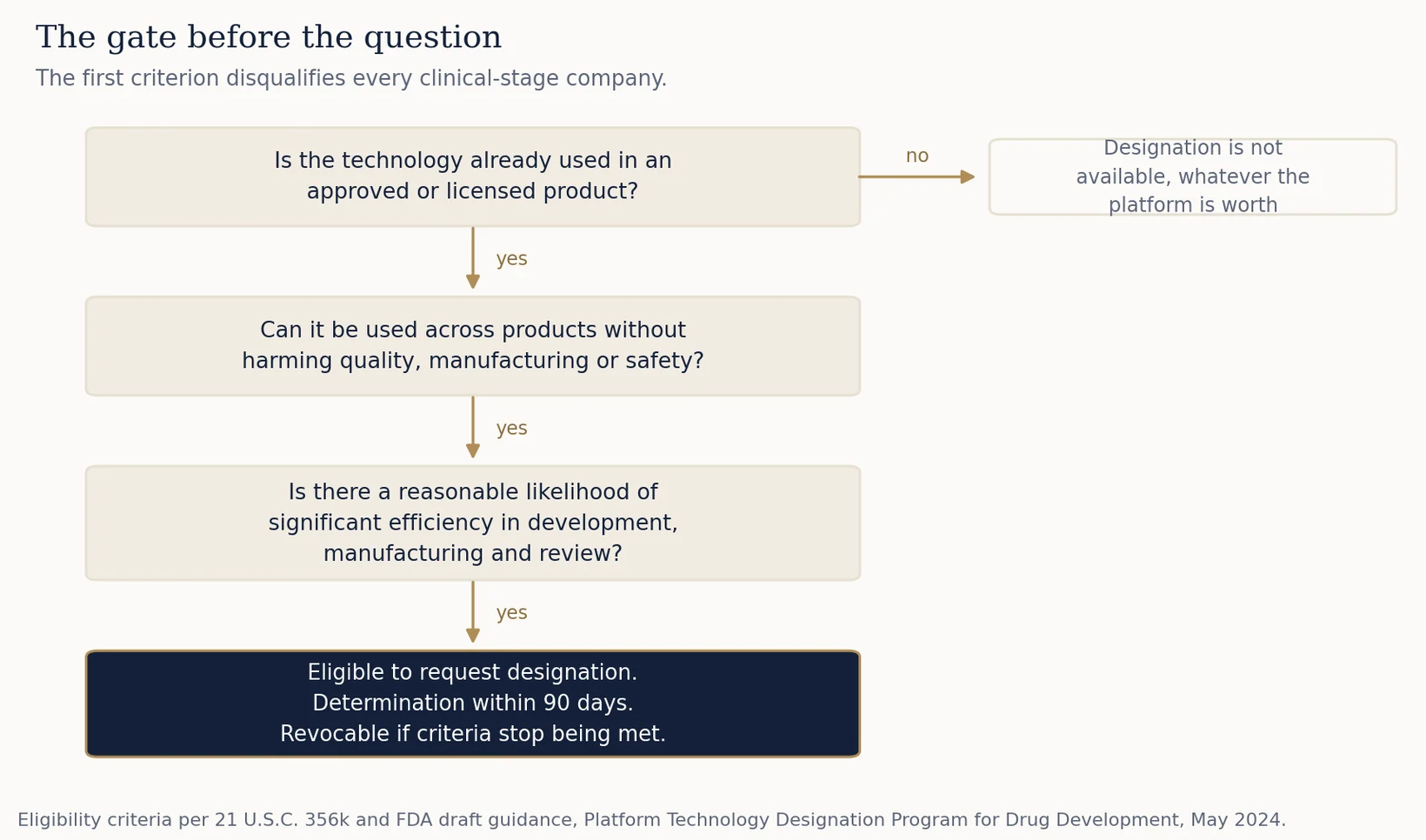
Exhibit 1. The eligibility path. The first criterion cannot be cleared before approval, which is what makes the designation a lagging signal. Source: The Modeste Duncan Group analysis.
Read that first criterion again, because its timing matters more than its content. Designation requires an approved product already using the technology. It therefore arrives after the point at which it would have been most useful, and a clinical-stage company has no route to it. Most sponsors know this. The mistake is rarely ignorance of the gate.
The designation is a lagging indicator. It confirms read-through that has already been demonstrated across an approved product and at least one more, which means it can never validate a claim at the moment the claim is being priced. By the time a company qualifies, the market has usually paid for the platform already, on evidence that has not yet been tested. Those intervening years are what this paper is about. Two further features of the program matter while you are in them.
Designation is granted to individual companies rather than to the technology itself, and can be revoked when the criteria are no longer met. A competitor's designation on a comparable technology confers nothing.
The developer community has raised a substantive concern that under the implementing guidance all platform information must be submitted with a license application rather than cited to a drug master file, which reduces the practical value of the designation. A sponsor describing designation as a submission shortcut is overselling it.5
The guidance remains in draft and is non-binding, so the picture is still moving.
3The Marginal-Cost Check
Technical diligence asks whether the science works. This asks a narrower and more answerable question: does program two cost less than program one, and by how much. I call it the Marginal-Cost Check, and it is the fastest way to find out whether a platform claim has been tested inside the company making it.
A sponsor who has built a platform can produce the figure in a day, because they have needed it themselves. A sponsor who cannot has never priced their own thesis. That is a finding, and it arrives before any scientific judgment is required.
Two refinements make the number usable. Ask what proportion of the saving came from the technology and what proportion came from the team having done it before, because the second does not compound. And ask what the third program is forecast to cost, because a platform's claim is that the gap widens.
4What the first revocation proved
The most instructive event in this program's short history is the one that went wrong.
FDA granted the first publicly disclosed platform technology designation in June 2025, for a viral vector used both in an approved gene therapy and in an investigational program for a different indication. After a patient in the investigational program died of acute liver failure, and two patients treated with the approved product also died of acute liver failure, the agency acted against the approved product and revoked the platform technology designation for the vector. The designation was revoked in July 2025, and the second designation was granted to a different company in October 2025 for a vector used in an approved product.
Set aside the specifics of the products. The structural lesson is the one every platform investor should carry.
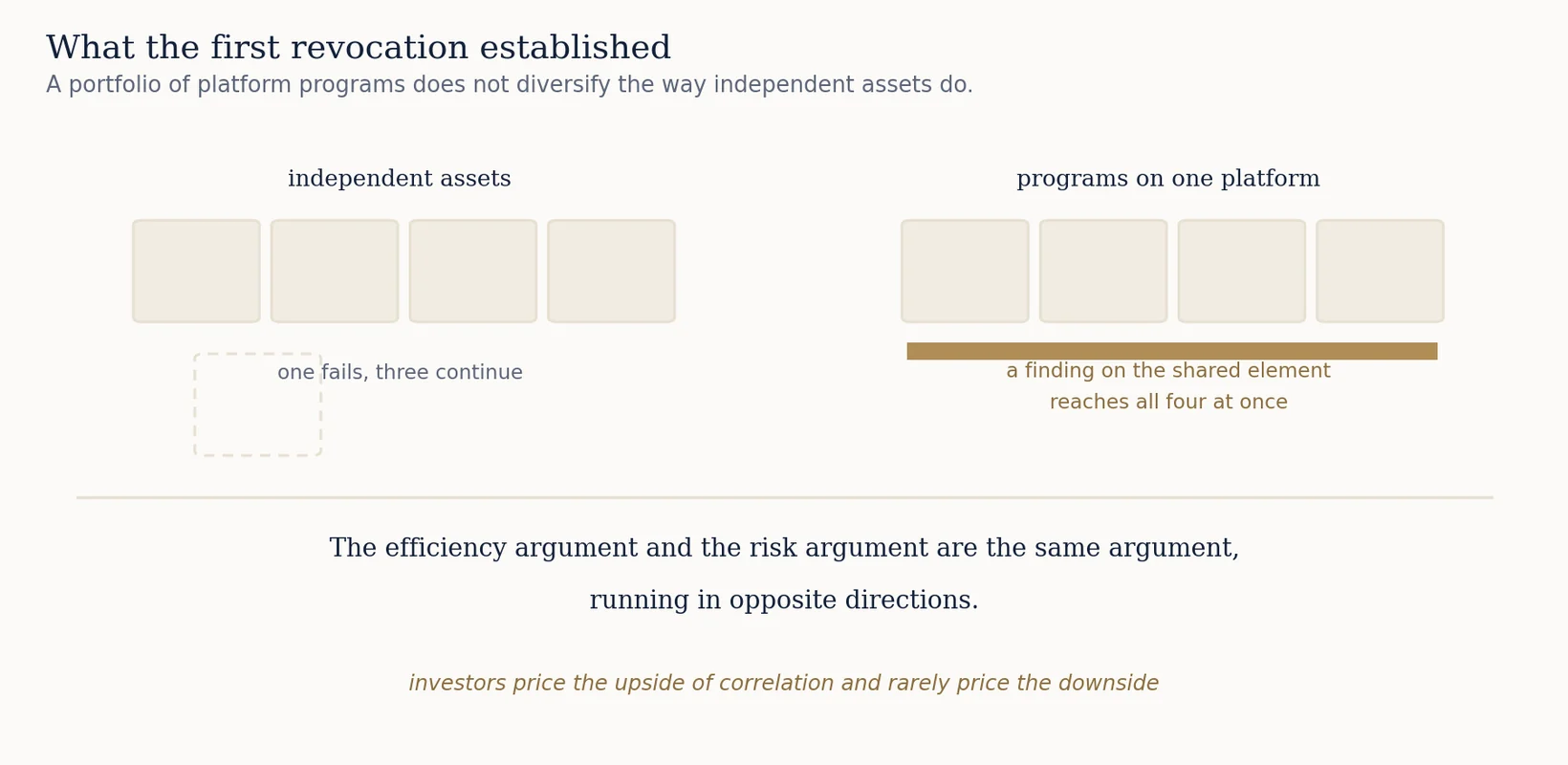
Exhibit 2. Why a platform portfolio does not diversify like independent assets. Source: The Modeste Duncan Group analysis.
A safety finding attributable to the shared element does not affect one program. It affects the designation, the approved product and every program relying on the vector, at the same time. The efficiency argument and the risk argument are the same argument, running in opposite directions.6
This is the part of platform investing that is routinely mispriced. The upside of correlation is what the platform multiple pays for. The downside of correlation is that a portfolio of platform programs does not diversify the way a portfolio of independent assets does, because the programs share a failure mode. Investors model the first and rarely model the second.
The diligence question that follows is specific: what single finding would attach to the shared element, and what would it do to every program at once?
5Five questions
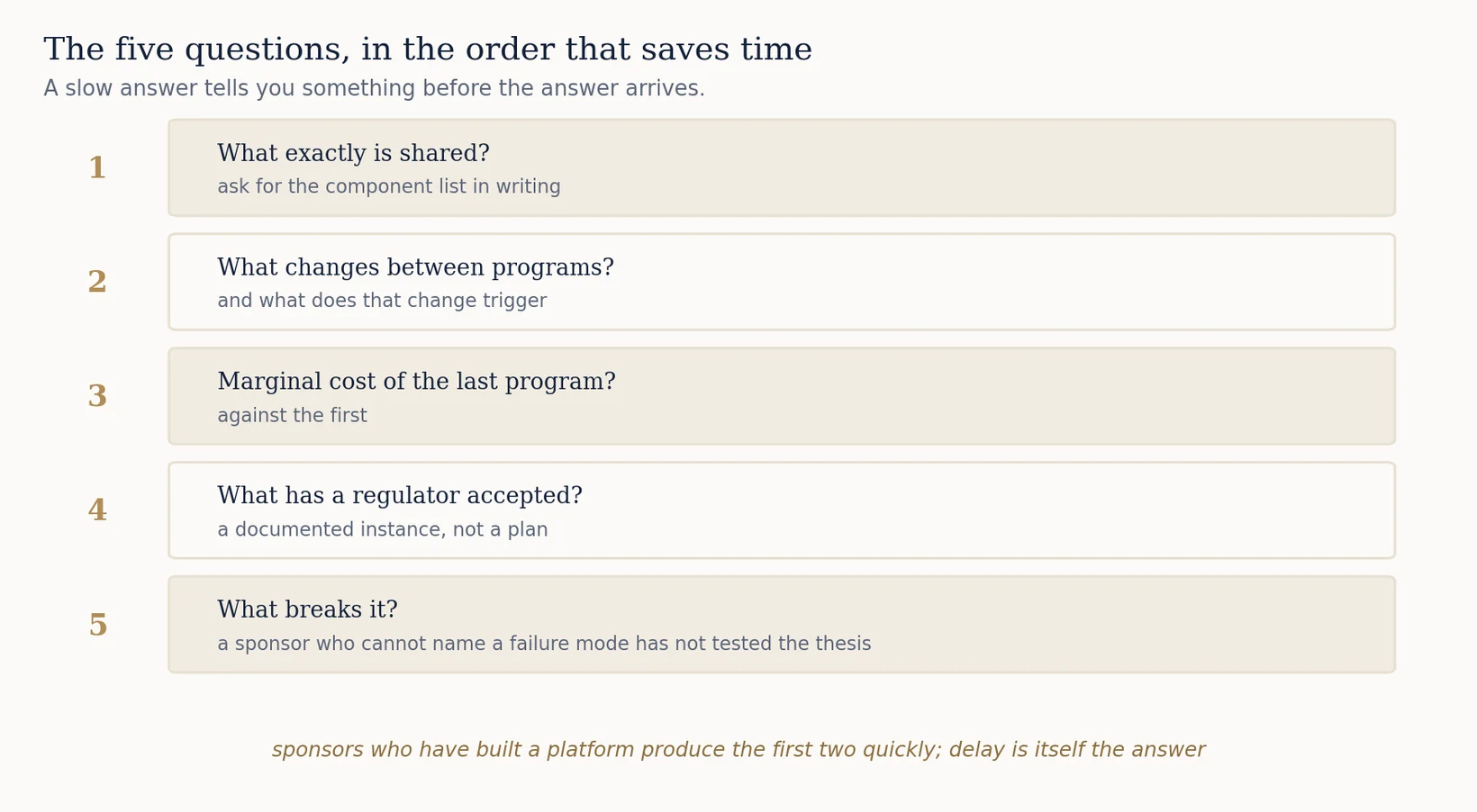
Exhibit 3. The diligence sequence, and what a slow answer signals. Source: The Modeste Duncan Group analysis.
What exactly is shared, expressed as a component list?
A real answer names the vector or delivery system, the manufacturing process steps, the analytical methods, the reference standards, the safety database. A weak answer describes an approach. Ask for the list in writing and read what is absent, particularly on the analytical side, because analytics is where read-through most often turns out to be thinner than the story.
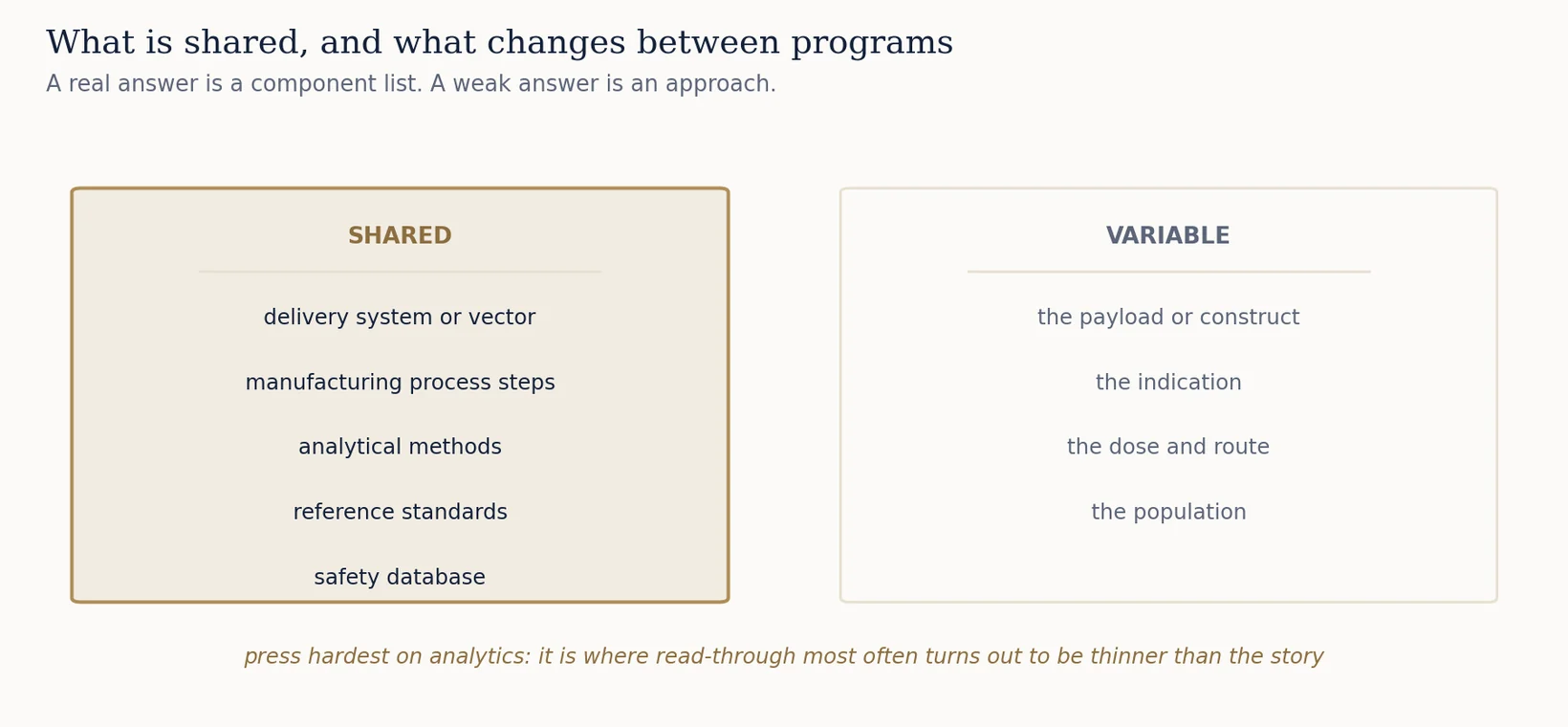
Exhibit 4. The component list a real platform can produce in writing. Source: The Modeste Duncan Group analysis.
What changes between programs, and what does that change trigger?
In a genuine platform the variable element is small and well characterized.7 Where the variable element requires new analytical methods, new toxicology or a new manufacturing process, the read-through is narrower than claimed.
What is the marginal cost and time of the most recent program, against the first?
If the sponsor cannot produce the figures, the thesis has never been tested internally. If the reduction is modest, ask what proportion came from technology and what proportion came from the team having done it before. The second kind of saving is real and does not compound the way a platform is supposed to.
What has a regulator actually accepted?
There is a large gap between a sponsor's belief that data will read across and an agency's agreement that it does. Ask for the specific instance where data generated for one program was relied upon for another, and what the agency said. A documented instance is a platform. A plan is a hypothesis.
What breaks it?
A sponsor who has thought about this will name realistic failure modes: a process change forcing comparability across every program, an off-target finding reading across the shared element, a safety signal in one program attaching to the common component. A sponsor who cannot name one has not stress-tested the thesis, and the claim is functioning as a valuation argument rather than as a development strategy.
6Where platform claims break
Divergence under commercial pressure
Platforms hold while programs are similar and strain when one program justifies a formulation change, a different dose or a different route, and the commercial case for it is compelling. Each divergence is individually rational and collectively erodes the common base. Ask what governance decides when a program may diverge and who holds that decision. Where each program team decides, the platform will erode.
Manufacturing as the true constraint
A technical platform running through more than one manufacturing process is several platforms. The element carrying the most weight in practice is usually the process and its analytics rather than the biology, and it is the least examined in diligence because it is the least accessible to a generalist investor.
The operating model quietly answering the question for you
A company running several programs holds either a portfolio, meaning assets sharing an organization, or a platform, meaning outputs of a shared technical and regulatory base. The two need different machinery. A portfolio needs prioritization, because programs compete for finite resources and someone has to choose. A platform needs read-through management, because the value comes from each program reducing the cost of the next, and that happens only if the shared elements are deliberately maintained as shared.
| Portfolio | Platform | |
|---|---|---|
| What is shared | An organization and its capital | A technical and regulatory base |
| Machinery it needs | Prioritization between competing programs | Read-through management across programs |
| How value is created | Each asset stands on its own | Each program lowers the cost of the next |
| Governance question | Which program gets the resource | When may a program diverge, and who decides |
| Failure mode | An asset fails alone | A finding on the shared element reaches all of them |
Exhibit 5. Source: The Modeste Duncan Group analysis.
Exhibit. Two operating models, and why running the wrong one destroys the economics.
This is worth checking directly, because it is diagnostic. A company that calls itself a platform and runs portfolio prioritization machinery is optimizing its programs against each other, which destroys the economics the platform claim was priced on. What the operating model does tells you what the company is, regardless of what the deck says.
Conclusion
The platform premium is one of the few valuation arguments in this sector that can be checked with arithmetic and a document request rather than with scientific judgment.
The two most productive requests are the component list in writing and the marginal cost of the most recent program. Sponsors who have built a platform produce both quickly. Delay in producing them is itself the answer.
A useful heuristic for reading what comes back: the strength of a platform claim tracks the specificity of the sponsor's account of its own limits. A sponsor who can tell you precisely where the read-through stops, which programs may diverge and under what governance, and what a regulator has and has not accepted, is describing something they have built. A uniformly positive account is describing an intention, which may still be a good investment and should be priced as an asset carrying an option on a platform.
From practice. I have been on the answering side of these questions. Building the center of excellence, the team structures and the governance for a new modality inside an established developer means being asked, repeatedly, to prove that program two will cost less than program one. The questions in section 5 are the ones I could not talk my way around.
Appendix A · Abbreviations and Key Terms
| ASGCT | American Society of Gene and Cell Therapy | DMF | Drug master file |
|---|---|---|---|
| BLA | Biologics License Application | FDORA | Food and Drug Omnibus Reform Act of 2022 |
| CBER | Center for Biologics Evaluation and Research | NDA | New Drug Application |
| CMC | Chemistry, manufacturing and controls | PTD | Platform technology designation |
Appendix B · References
Statutory and regulatory citations reflect settled United States law unless identified as draft. FDA and ICH documents were confirmed against primary sources as of May 2026. Draft guidances are identified as such and remain subject to change. The platform technology designation guidance remains in draft and the program is administered case by case. Confirm current status before relying on a position. Citations were verified to September 2026; where a source postdates the paper, the later status is given.
1. 21 U.S.C. §356k (Platform technologies), added by the Food and Drug Omnibus Reform Act of 2022 within the PREVENT Pandemics Act, Consolidated Appropriations Act, 2023, Pub. L. No. 117-328.
2. U.S. Food and Drug Administration. “Platform Technology Designation Program for Drug Development; Draft Guidance for Industry.” May 2024. Docket FDA-2024-D-1829; 89 Fed. Reg. 46407.
3. 21 U.S.C. §356k(b): eligibility criteria, requiring that the technology be incorporated in or utilized by a drug approved under an NDA or a biologic licensed under a BLA.
4. 21 U.S.C. §356k(d): determination within 90 days of receipt; §356k(f): revocation where the technology no longer meets the eligibility criteria, communicated in writing with rationale.
5. American Society of Gene and Cell Therapy. Policy comment on the Platform Technology Designation Program, addressing drug master file referencing and reviewer burden.
6. Contemporaneous reporting on the grant, revocation and subsequent second grant of platform technology designations, 2025. See Precision Medicine Online, BioSpace and CGTLive coverage; and the statement of the Director, Center for Biologics Evaluation and Research, July 2025.
7. U.S. Food and Drug Administration. “Leveraging Prior Knowledge in the Development of Human Gene Therapy Products Incorporating Genome Editing; Draft Guidance for Industry.” June 2026.
Published May 2026 by The Modeste Duncan Group, which owns this paper and the methods it describes. Clients receive a license to use them;
